Does a Coffee Subscription Service Actually Save You Money?
Does a Coffee Subscription Service Actually Save You Money?
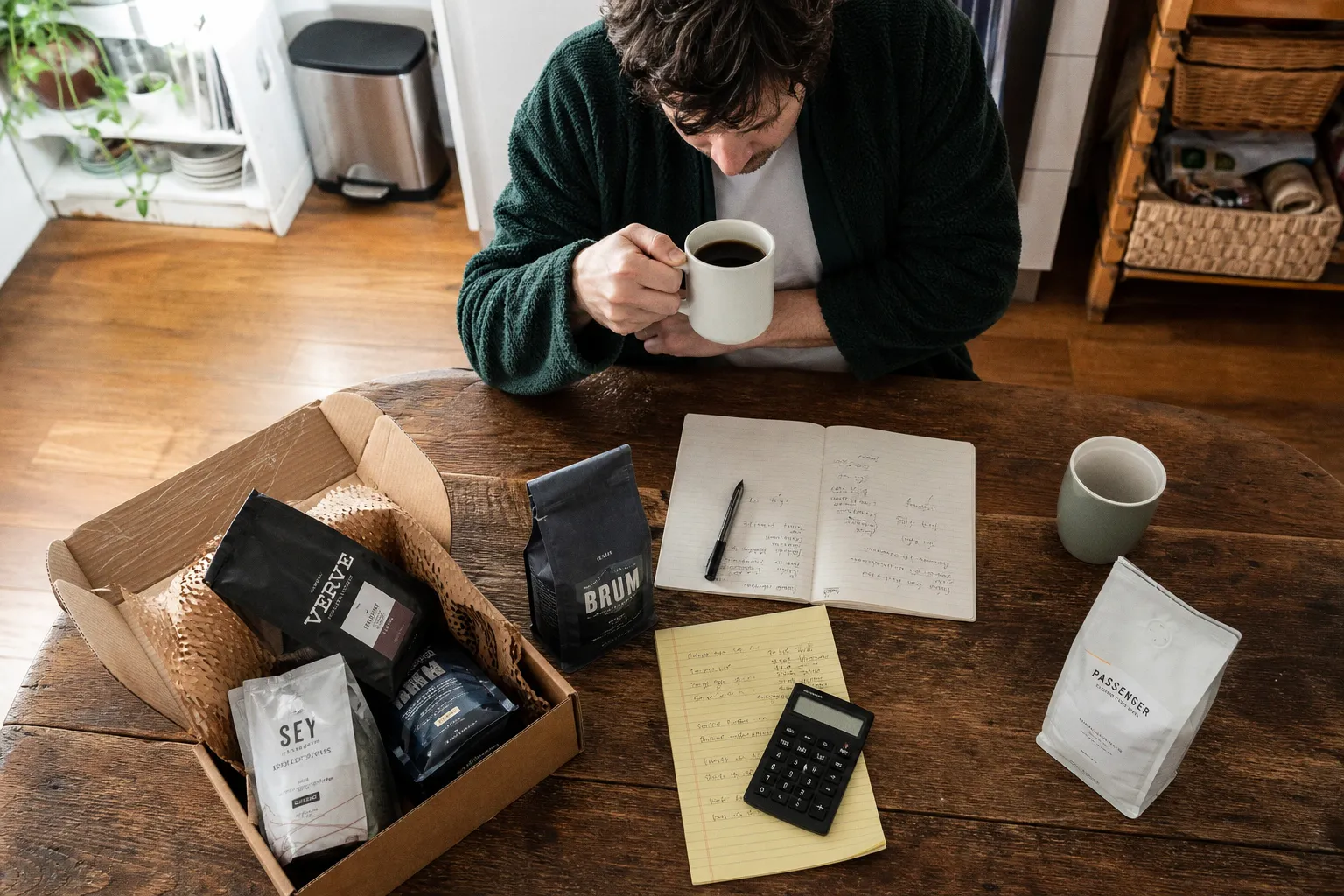
I've been running subscription coffee through my kitchen for the better part of two years now, switching between two-bag-a-month and four-bag-a-month cadences, alternating roasters, and tracking every charge against what I'd otherwise spend on beans. The honest answer to whether a coffee subscription service saves you money is — it depends entirely on what you'd be doing instead. If your fallback is a $5 café latte every morning, the math leans heavily in the subscription's favor. If your fallback is a $9 bag of grocery-store grounds you brew at home, the math looks almost punishing. So before you sign up for another six-month commitment, let me walk you through the actual numbers and the decision points that don't show up on the marketing page.
The True Cost of Your Morning Brew: Subscription vs. Grocery Store
Let's lay out the real per-cup economics, because that's where most subscriptions look either brilliant or ridiculous depending on your baseline. A specialty subscription bag typically lands between $15 and $22 for 12 ounces, with another $3 to $8 in shipping layered on top. A 12-ounce bag yields roughly 24 cups of decent home-brewed coffee, give or take your ratio. Run that math and you're looking at $1.50 to $2.50 per cup for subscription coffee, all in.
By contrast, a generic grocery store bag of decent-tasting beans — something from the local supermarket's mid-tier shelf — runs about $9 to $14 for 12 ounces and yields the same 24-ish cups. That's $0.40 to $0.60 per cup on average. If you're a creature of habit who treats coffee as a caffeine delivery system and not a hobby, this is where the cost story starts to tilt away from the subscription model in a hurry.
A daily café latte or cortado sits in a completely different orbit — somewhere between $4 and $6 in most cities, north of $6 if you're in a metro area or grabbing anything with oat milk inflation built in. So the per-cup math actually creates three clear tiers:
| Brewing source | Typical per-cup cost | Where it falls |
|---|---|---|
| Standard grocery store beans, home-brewed | $0.20 – $0.50 | Cheapest — pure caffeine economics |
| Specialty coffee subscription service | $1.50 – $2.50 | Mid-tier — flavor and convenience premium |
| Daily café latte / espresso drink | $4.00 – $6.00+ | Most expensive — labor + real estate + craft |
A coffee subscription isn't a savings play against the grocery store. It's a savings play against the café. That framing matters, because half the subscribers I talk to think they're getting boutique beans at wholesale prices. What they're actually getting is boutique beans with a curation and delivery layer — and that layer costs something real.
A coffee subscription isn't cheap coffee. It's curated coffee. The savings story only works if your comparison point is the café, not the supermarket shelf.
Decoding the Price Gap: Why Specialty Beans Command a Premium
If you've ever opened a subscription bag and compared it side-by-side with a $10 supermarket bag, you know immediately why the price difference exists. The aroma alone is a giveaway — fresher roasted, often single-origin, frequently traceable back to a specific farm or cooperative. That kind of sourcing doesn't happen at the scale of mass-market coffee. Most roasters running subscription programs operate on a small-batch model: they buy green coffee in 50–150 bag lots, develop roast profiles for each lot, and roast-to-order so the beans hit your door within days of leaving the drum, not weeks or months.
This is also why subscription bags look slightly different from grocery store cans. They usually ship in valve-sealed bags with a one-way degasser, which lets CO2 out without letting oxygen in. That bag tech isn't decoration — it's what keeps roasted coffee from going stale in the seven to fourteen days between roast date and your morning brew. Premium bags, nitrogen-flushed where applicable, often carry a visible roast date so you know exactly when the clock started.
Then there's the curation layer: someone at the roastery is tasting each lot, writing flavor notes, deciding what pairs with what, and shipping you a rotation rather than asking you to pick from a wall of unfamiliar origins. That's labor, and labor costs money. The flip side is that you, the drinker, get to develop palate range without becoming a buyer at a specialty roaster's retail counter every week. There's real value there — just know it's a different kind of value than raw cost savings.
Hidden Logistics: How Shipping Fees and Frequency Impact Your Wallet
The single biggest line item that blindsides new subscribers is shipping. Most subscription services price their bag at $15 to $22, then quietly tack on $3 to $8 per delivery on top of that. A monthly plan with $6 shipping adds $72 a year in pure logistics. That's enough to buy nine extra bags at the grocery store tier. If you're on a higher-frequency plan — every two weeks instead of every month — that annual shipping cost roughly doubles.
Some services offer free shipping above a certain threshold, typically two or three bags. Others bundle every-other-week shipments into a flat-rate envelope that reduces per-delivery impact. A few swallow shipping entirely on quarterly or seasonal plans. None of this shows up in the headline price on the subscription landing page, and most of it doesn't even show up until you've already entered your credit card and clicked through to the shipping calculator.
The cadence question matters more than people realize. A single-bag, every-four-weeks plan has the highest per-bag logistics overhead. A two-bag, every-four-weeks plan amortizes shipping across more coffee and gets you closer to the actual product cost. A four-bag, every-eight-weeks bulk shipment often wins on pure economics, especially if the roaster offers a recurring-order discount on top. The takeaway: frequency isn't just about how fresh you want your beans. It's a real lever on whether the subscription math works.
Maximizing Value Through Bulk Orders and Loyalty Discounts
Here's where the cost story starts to bend back toward the subscription's favor. Most roasters running subscription programs offer meaningful breaks for buyers who commit ahead. The typical loyalty discount range lands somewhere between 5% and 15%, depending on the roaster, the commitment length, and the bag count. Some services layer free shipping on top of that discount if you commit to a minimum cadence. A few offer referral credits — typically $10 to $25 toward your next order — that effectively refund a chunk of one shipment.
The loyalty tier that almost always pays off is the largest bulk tier. If a roaster offers a four-bag quarterly shipment with free shipping and 10% off, you're suddenly looking at four 12-ounce bags at maybe $16 each, with the shipping line item gone entirely. That's a substantial move down the per-cup cost curve — enough to push your effective cost into the $1.10 to $1.40 per cup range. At that point, the subscription starts looking like a smarter way to access specialty coffee than walking into a third-wave café and asking for a Chemex brew.
Two other realistic levers. First, many services let you pause or skip a month without canceling — use that during travel or when you're still working through prior bags. Skipping one billing cycle in three recovers roughly $20 to $30 across a year. Second, a couple of services let you split shipments with a friend or family member at the same address, which lets you access bulk discounts without doubling your bean intake. If you've got a coffee-positive household, this is the easiest savings hack on the board.
When a Subscription Service Actually Makes Financial Sense
So when does a coffee subscription service genuinely save you money? Three scenarios cover most of the cases I see in real testing.
First, you've been a daily café customer. If you're currently spending $5 a day on lattes or americanos on your way to work, a $19 bag that lasts you about 12 workdays (24 cups, half used at home, half during morning departure) translates to roughly $1.60 per brewed cup versus $5 paid at the counter. Add the time and gas savings, and the subscription wins by a wide margin. This is the cleanest savings case.
Second, you already buy specialty coffee at retail. If your current habit is stopping at a local third-wave roaster and dropping $18 to $24 per bag, you're already paying subscription-tier prices — and you're usually paying full sticker, no discount, plus the round trip to the shop. A subscription beats that on logistics alone, and on price if you've got a loyalty tier or bulk cadence locked in.
Third, you treat coffee as a hobby. Some people — myself very much included — drink coffee because they like exploring what a Yirgacheffe natural or a Sumatra Mandheling tastes like when it's dialed in right. That's experiential value, not commodity value. If you've ever been bitten by the food-discovery bug — whether from sampling safe street food in Delhi on a trip abroad or chasing new vendors at the local farmers market — you already understand how a curated coffee subscription satisfies the same impulse. The cost-per-cup math looks worse than a generic bag, but the experience-per-dollar is its own category, and it's the one that justifies the rest of the subscription economy.
For everyone else — the daily home brewer who treats coffee as caffeine and shops the mid-tier grocery shelf — the subscription math usually doesn't work out. You'd be paying a 3x to 5x premium per cup for sensory gains that may not register on your palate.
The honest verdict: a coffee subscription service is a savings play when you trade café visits for home brewing, a convenience upgrade when you trade retail roaster trips for doorstep delivery, and an experience upgrade when you trade commodity beans for curated discovery. It's not, on the numbers, a way to get cheaper caffeine.
Before you commit to any service, do the quick math for your own situation. Look at three numbers: your current per-cup cost, the subscription's all-in price per cup including shipping, and the length of any commitment discount. If the second number beats the first by enough margin to make the hassle worth it, you're in the green. If it doesn't, the curated-coffee experience is still a valid reason to subscribe — just know you're paying for discovery, not for thrift.