Kids subscription box guide: what to buy and what to skip
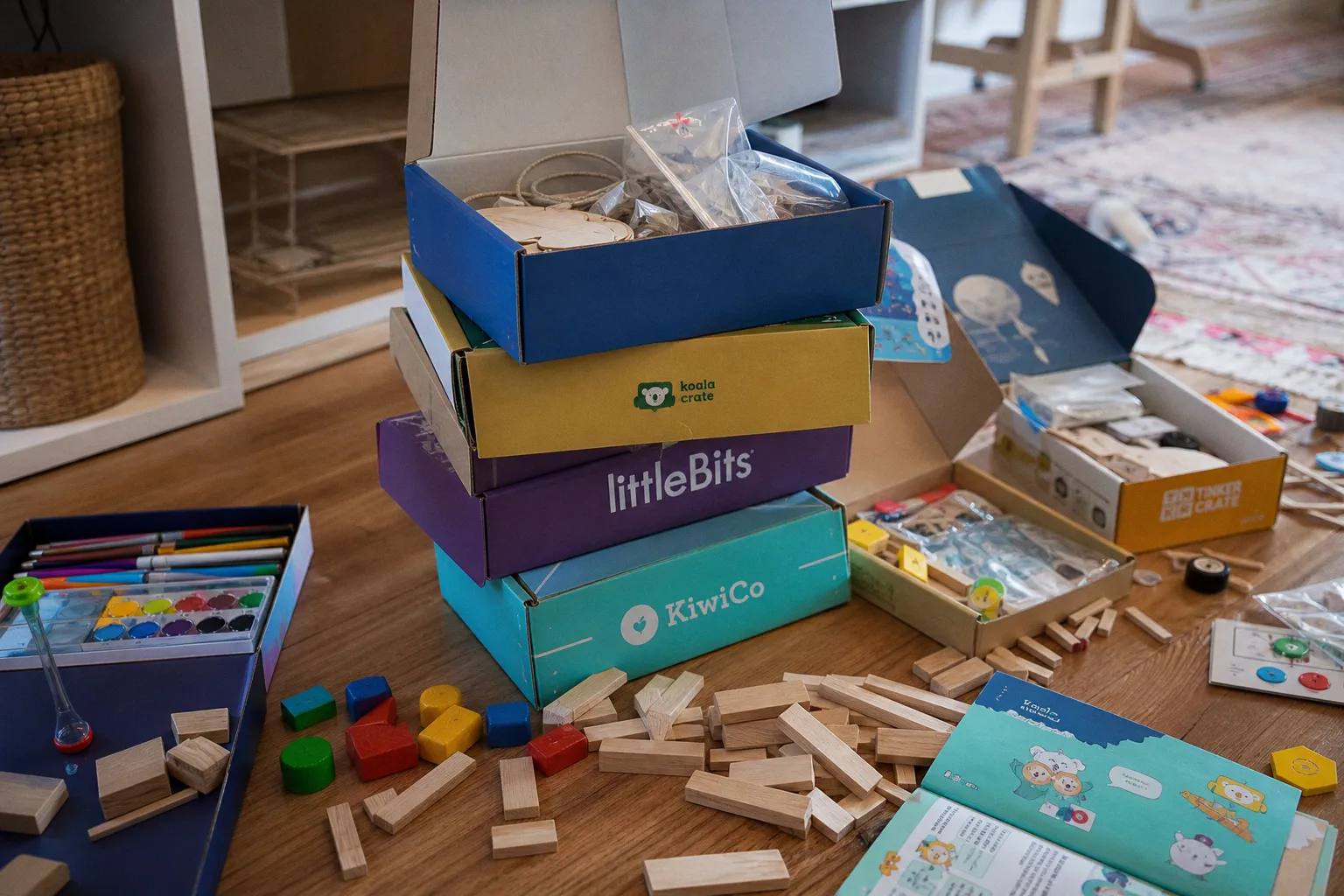
The market is crowded because the promise is good: monthly STEM kits, book clubs, sensory bins, craft boxes, toddler toy rotation, homeschooling activity kits. The problem is that too many boxes sell the parent a fantasy of independent learning and ship the child a pile of adult-assembly parts. I look at these boxes the same way I look at any educational toy: What skill is it building? How long does it hold attention? How much parent labor does it require? And will it survive being stepped on, mouthed by a younger sibling, or shoved into a bin with train tracks?
Mapping the landscape: four box types, four very different jobs
Most kids’ subscriptions fall into four practical categories: educational/STEM, book clubs, arts and crafts, and toy rotation or sensory play. Marketing pages like to blur these together. At home, they behave very differently.
| Box type | What it usually includes | Best age fit | Parent involvement | Mess factor | What to watch |
|---|---|---|---|---|---|
| STEM / educational kits | Experiments, engineering builds, coding activities, science materials | 3–5 through 14+ | Medium to high, depending on instructions | Low to medium, sometimes high with chemistry kits | Overpromising academic gains; flimsy parts |
| Book clubs | Picture books, early readers, chapter books, graphic novels, nonfiction | 0–14+ | Low, unless reading support is needed | Low | Poor reading-level matching; duplicate books |
| Arts and crafts boxes | Paint, clay, beads, paper crafts, sewing, seasonal projects | 3–12 | Medium, often high for preschoolers | Medium to high | Tiny pieces, drying time, cleanup creep |
| Toy rotation / sensory play | Rental toys, Montessori-style manipulatives, sensory fillers, pretend play items | 0–6 mostly | Low to medium | Low for toy rental; high for sensory bins | Choking hazards, sanitation, lost-piece fees |
A STEM box is not just a more “serious” craft box. A craft box can build fine motor skills, sequencing, bilateral coordination, and frustration tolerance. A STEM box can still be mostly decoration if the child is snapping pre-cut pieces into a robot shell without understanding cause and effect. The label matters less than the task.
For related context, see Here's what smart people are saying about the latest global stock sell-off.
For preschoolers, I look first for open-ended manipulation: sorting, measuring, color matching, simple circuits, ramps, magnets, pattern blocks. For elementary kids, I want a clean bridge between hands-on activity and explanation. For older kids, especially 10–14+, the kit needs enough complexity to avoid feeling babyish: real coding logic, structural engineering tradeoffs, circuitry that can fail and be corrected, not just “decorate the volcano.”
A good kids subscription box does not need to be impressive in the unboxing photo. It needs to hold up on the second Tuesday, when nobody has time to supervise a museum-quality learning moment.
Match the box to the child’s actual developmental stage, not the aspirational one
Age ranges on kids’ subscription boxes are broad because companies need them to be. Real children are inconveniently specific. A 5-year-old who can follow three-step instructions and wait for glue to dry is in a different universe from a 5-year-old who still peels stickers off before hearing the directions.
The common age bands are useful only as a first filter:
1. Ages 0–2: toddler and early sensory exploration.
Look for chunky pieces, cause-and-effect toys, board books, soft materials, nesting, stacking, and simple shape play. Avoid anything with beads, magnets that can come loose, button batteries, or sensory fillers that become a choking hazard. “Independent play” here means three to eight minutes nearby, not you leaving the room to answer email.
2. Ages 3–5: preschool and early learners.
This is where many STEM-focused boxes begin. The best ones build sorting, counting, early spatial reasoning, simple observation, vocabulary, and fine motor control. Parent supervision is still non-negotiable for scissors, liquids, small parts, and anything that says “adult help required” in tiny print after checkout.
3. Ages 6–9: elementary builders and readers.
This is the strongest zone for many kids activity boxes. Children can follow illustrated instructions, test a hypothesis, read simple background text, and revisit a project later. I want kits that allow a child to make at least one meaningful choice: change the ramp angle, adjust the sail, test different weights, choose a story path, build a second design.
4. Ages 10–14+: older kids and real complexity.
At this point, cute packaging is not enough. Middle-grade and early teen boxes need better materials, clearer conceptual depth, and less hand-holding. Coding, robotics, advanced engineering, creative writing, graphic novels, and nonfiction clubs can work well. A box that feels “schoolish” without being challenging dies fast.
The most common buying mistake is subscribing for the child you hope will appear after the first box arrives. If your kid currently hates multi-step crafts, do not buy a twelve-month craft subscription because the product photos show serene children painting wooden planets. If your child devours graphic novels but resists prose chapter books, a customizable book club may do more for literacy stamina than a worthy stack of award-winning novels that sit untouched.
The attention span test I use before recommending renewal
A single unboxing can fool you. New items always get a bump. I care about whether the box survives the week.
For each box, I track:
- First-session engagement: Did the child start without heavy persuasion? Did the activity last long enough to justify setup?
- Instruction independence: Could the child follow the booklet alone, or did I become the unpaid project manager?
- Return rate: Did they come back to it within three days?
- Sibling interference: Did the box create a fight, a shared activity, or a safety problem?
- Cleanup recovery: Could the house return to normal in under 10 minutes?
- Durability: Did parts bend, crack, leak, shed fibers, lose magnets, or become useless after one build?
This is where many pretty subscriptions fail. They photograph well and collapse under normal household pressure. A paper craft with 19 delicate cutouts may be lovely, but if it requires constant adult rescuing, it is not independent play. A simple set of interlocking gears that can be rebuilt six ways may look less premium and still deliver better problem-solving.
STEM boxes: useful when they teach the process, not just the trick
A solid STEM subscription box gives children a loop: build, test, observe, change, try again. The weak ones give children a trick: pour this into that, watch foam happen, throw away the cup.
STEM-focused subscriptions often sort by age, from early learners around 3–5 to advanced engineering or coding around 14+. That range matters because the same subject can be developmentally rich or completely wrong depending on the execution. Electricity for a 6-year-old might mean safe snap circuits and a light bulb. Electricity for a 12-year-old should involve resistance, polarity, troubleshooting, and actual decisions.
In a stem subscription box comparison, I do not start with “which one looks most educational.” I start with the failure points:
- Are the materials real enough to teach something? Cardboard is fine if the concept is structure or airflow. It is not fine if the hinge fails before the child can test the machine.
- Does the instruction booklet explain why? A child can assemble a catapult and still learn nothing about stored energy if the guide only says “Step 7: launch!”
- Is there room for iteration? One-and-done experiments have low value unless the observation is unusually strong.
- Can mistakes be fixed? If one wrong fold ruins the whole project, younger kids will need adult hands.
- Does it require household extras? Needing water is normal. Needing vinegar, tape, coins, food coloring, a screwdriver, and a baking tray is how a box becomes a scavenger hunt.
The best educational boxes for kids do not pretend a monthly kit will turn a child into an engineer. They provide repeated contact with useful habits: measuring, predicting, testing, noticing patterns, and tolerating failure. That is enough. That is also harder to deliver than a box full of plastic “science” props.
If the adult has to do the measuring, cutting, troubleshooting, and explaining, the child did not receive a STEM kit. The parent did.
Book clubs are often the least flashy and most durable subscription
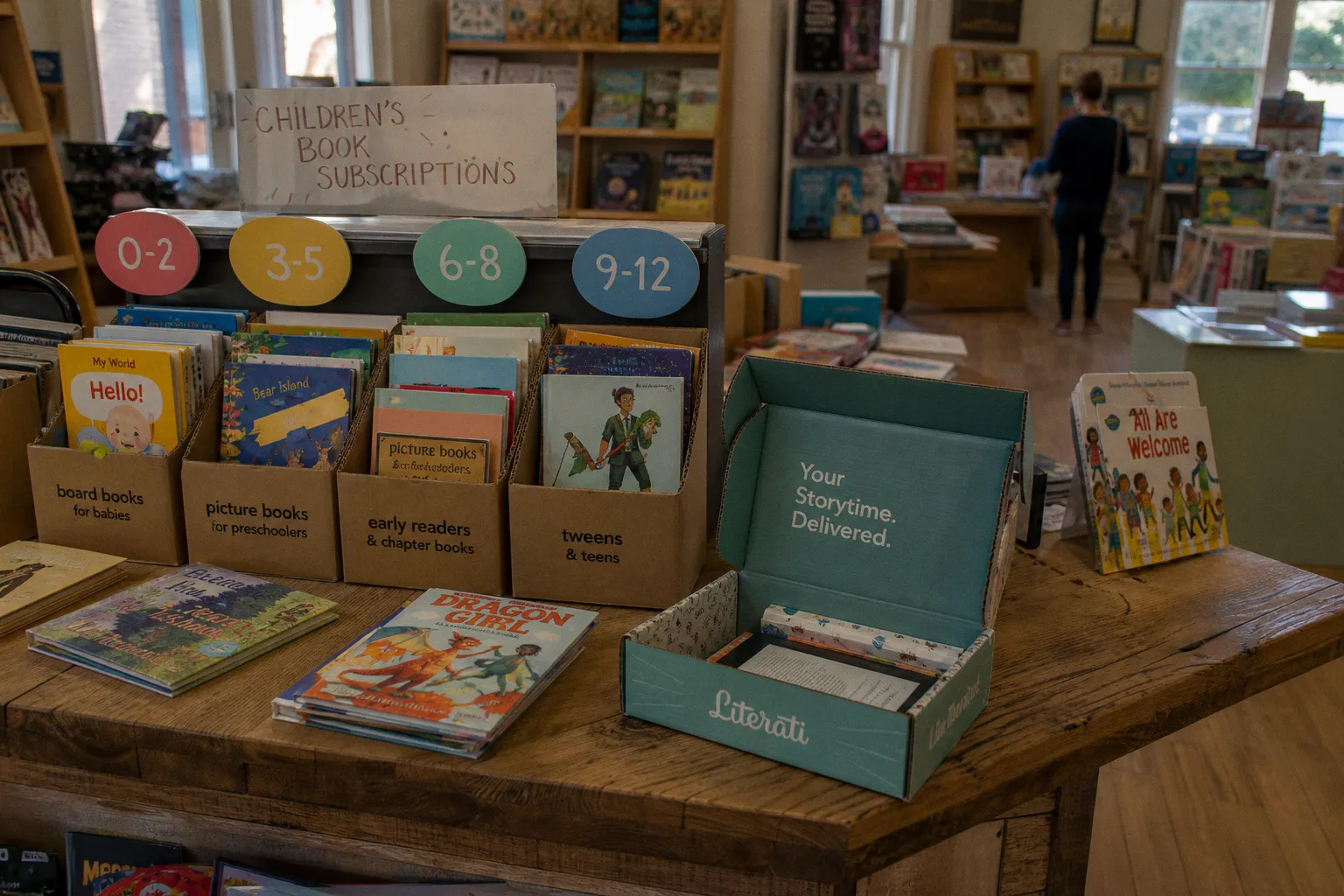
Book subscription boxes rarely win the dramatic unboxing contest. No fizzing reaction. No tiny wooden spacecraft. No bag of pom-poms rolling under the table. But for many families, a well-matched children’s book club has the best ratio of value to cleanup.
The useful feature here is customization. Many book boxes let you select by reading level, age, format, or interest: early readers, nonfiction, graphic novels, chapter books, picture books, seasonal themes. This matters because reading identity is fragile. A child who thinks “books are not for me” may actually mean “adults keep handing me books at the wrong level about things I do not care about.”
For book clubs, I look at:
- Reading level fit: Is the text too easy, too hard, or properly stretch-level?
- Format variety: Some kids need graphic novels, joke books, field guides, or nonfiction to stay engaged.
- Re-read value: Picture books and strong nonfiction often get revisited; flimsy novelty books do not.
- Duplicate control: If your household already buys books often, check whether the service allows exclusions or preference notes.
- Ownership vs. clutter: Books accumulate fast. That is not automatically bad, but small homes feel it quickly.
A book box is also one of the better choices for grandparents or relatives who want to give a recurring gift without sending plastic. Still, “educational” does not mean “universally useful.” If the service ignores your child’s reading level, you will end up with a neat stack of guilt. And guilt is not literacy.
Arts, crafts, and sensory boxes: excellent skill-building, if you respect the mess factor
Craft boxes for kids can be genuinely valuable. They build fine motor skills, hand strength, planning, sequencing, visual discrimination, and persistence. They can also quietly require a parent to clear the table, cover the floor, supervise glue, decode instructions, wash brushes, locate a drying zone, and keep the toddler from eating googly eyes.
The phrase “mess-free craft” deserves suspicion. There are lower-mess crafts. There are contained crafts. But if a box includes paint, kinetic sand, glitter, slime, dye, clay, or loose sensory fillers, assume cleanup is part of the subscription fee.
I divide craft and sensory boxes into three household categories:
| Mess level | Typical materials | Good for | Parent reality |
|---|---|---|---|
| Low | Stickers, foam shapes, lacing cards, washable markers, pre-cut paper | Quick after-school activity, travel, younger kids building fine motor skills | Usually manageable with light supervision |
| Medium | Paint sticks, glue, beads, air-dry clay, simple sewing, paper construction | Preschool and elementary skill-building | Needs table prep and a defined stopping point |
| High | Slime, glitter, liquid experiments, sensory rice, water beads, dyes | Sensory seekers, outdoor play, supervised weekends | Requires close supervision and cleanup plan |
For toddlers and preschoolers, choking hazard screening comes first. Any subscription that sends small beads, loose caps, mini erasers, foam pellets, magnets, or water beads into a home with children under 3 needs careful handling. Even if the target child is older, younger siblings change the safety equation.
Sensory play subscriptions can be wonderful for children who regulate through tactile input. They can also become expensive bins of filler if the theme matters more than the play function. I prefer sensory boxes that include durable tools: scoops, tongs, tweezers, cups, molds, washable figures, textured balls. Those tools keep working after the themed filler is gone.
Toy rotation services solve clutter, but read the lost-piece rules
Toy rotation services are the practical cousin of the toy subscription service. Instead of owning every item, you rent or borrow high-quality toys, use them for a period, then return them for the next set. Many operate on a circular economy model, which can reduce household waste and toy pileup when the logistics are handled well.
For babies and toddlers, this can make sense. Development changes quickly from 0–2. A toy that is perfect for posting, grasping, or object permanence may be irrelevant six weeks later. Rotation also helps parents avoid buying large wooden toys that look beautiful and then occupy permanent floor space.
But monthly toy subscription pitfalls are real:
- Lost pieces can turn into stress. If your child scatters puzzle knobs, shape sorters, or pretend food under furniture, check the replacement policy before you subscribe.
- Sanitation needs to be transparent. A rental toy service should explain cleaning practices clearly. Vague “carefully sanitized” language is not enough for items that babies mouth.
- Shipping cadence matters. Monthly can feel too fast for some toddlers; quarterly may be enough.
- Attachment happens. Some children do not appreciate returning a favorite toy because a billing cycle says so.
- You still need storage discipline. Rotation reduces ownership clutter, but only if returned items actually leave the house on time.
Toy rotation is not for every family. If you dislike tracking returns, or if your child forms intense attachments to specific toys, ownership may be calmer. But for small spaces and fast developmental stages, it is one of the few subscription models that can honestly reduce clutter instead of importing it.
The economics: the real price is not just $20 to $50
Most kids subscription boxes sit roughly in the $20–$50 per box range, depending on materials, complexity, licensing, shipping, and whether the subscription is monthly or quarterly. That can be reasonable. It can also turn into a quiet leak in the family budget, especially if three different children each have “just one” box.
The cost question is not “Can I afford the monthly charge?” It is “Would I buy this exact pile of materials at a store for this price, knowing the cleanup and storage cost?”
A $25 book club with two well-matched books can be excellent. A $35 STEM kit with one strong reusable component and a solid guide can be worth it. A $45 craft box that produces three fragile decorations and a sink full of paint water may not be.
When judging value, I use a blunt breakdown:
1. Consumable vs. reusable value.
Paint, paper, stickers, and experiment powders disappear. Building pieces, tools, books, and manipulatives keep earning their space.
2. Time-on-task.
A box that holds focused attention for 45 minutes and invites a second session beats a box that creates one 12-minute burst.
3. Parent labor.
If I must supervise every step, the box is competing with activities I could assemble myself.
4. Storage impact.
Large finished crafts, half-used material bags, and specialty parts without a system become clutter fast.
5. Sibling scalability.
Some boxes work for multiple children. Others trigger immediate conflict because there is one “good” tool or one final product.
6. Cancellation friction.
If a company makes it hard to pause or stop, that cost belongs in the price.
Many services offer skip-a-month or cancel-anytime features. Those are not bonus perks; they are basic survival tools for families. Children get sick. School gets busy. A grandparent drops off a bag of toys. Suddenly the “monthly enrichment” box is three unopened mailers deep in the closet.
Cancellation policies: boring until they cost you money
I read cancellation terms before I get emotionally attached to a subscription. Most family-friendly services allow cancellation or skipping before the next billing cycle, often with a notice period of about 1–5 days. That small window matters. Miss it, and another box ships.
Look for the billing mechanics, not just the marketing headline:
- Can you skip a month from your account dashboard, or do you have to email support?
- Is “cancel anytime” actually immediate, or does it apply after a prepaid term?
- What is the cutoff before renewal: one day, three days, five days?
- Are prepaid multi-month plans refundable?
- Can you change age level or category without starting a new subscription?
- Does the company send renewal reminders?
This is especially important with seasonal boxes and quarterly plans. Quarterly can be a better rhythm for busy families, but a missed cancellation may mean paying for a larger shipment you no longer want.
I do not punish a subscription for having clear rules. Businesses need billing schedules. I do penalize vague cancellation language, hidden renewal timing, and account systems that turn a simple pause into a customer-service errand.
How I decide what to buy, pause, or skip
Here is the practical sorting system I use after testing kids activity boxes in a real household, where the table is never fully clear and someone is always missing a sock.
Buy if the box does at least three of these well
- The age match is honest. The child can do meaningful parts independently, not just watch an adult assemble.
- The core material quality is solid. Pieces fit, books are well-bound, tools do not bend immediately, and instructions survive handling.
- It supports a real developmental skill. Fine motor skills, early literacy, spatial reasoning, problem-solving, sequencing, sensory regulation, sustained attention.
- It allows repeat use or repeat thinking. Rebuilding, rereading, retesting, remixing, or extending the activity.
- Cleanup is proportional. A high-mess box can be worth it, but not for a five-minute payoff.
- The subscription is flexible. Skipping, pausing, canceling, and changing levels should be straightforward.
Pause if the problem is timing, not quality
Some boxes are good but arrive too often. If your child likes the kits but they stack up unopened, the fix may be quarterly delivery or skipping months. This is common with STEM and craft boxes because they require a clear block of time. Books tolerate backlog better than slime kits.
Skip if the box depends on parent performance
The harshest category is the box that looks educational but only works when an adult is fully engaged, cheerful, and available. That is not automatically bad—some family projects are worth doing together. But do not buy it under the promise of independent play.
Skip boxes that:
- rely on tiny fragile parts for young children;
- use “STEM” as decoration without explaining the concept;
- require too many household supplies;
- send crafts that cannot survive normal handling;
- ignore reading level or child interests;
- make cancellation harder than ordering;
- produce more clutter than use.
My strict verdict: subscription boxes are tools, not magic
A kids subscription box can be worth it when it solves a real household problem: you need fresh reading material, structured weekend projects, age-appropriate STEM exposure, toddler toy rotation, or low-prep activities for homeschooling gaps. The best ones respect child development and parent bandwidth at the same time.
The boxes to skip are the ones selling parental reassurance in a pretty mailer. If the activity requires constant adult rescue, creates disproportionate mess, or teaches less than the packaging implies, the subscription fee is doing too much emotional work.
My standard is simple: the child should get the learning, not just the delivery thrill; the parent should get convenience, not another unpaid job. If a box can clear that bar for your child’s age, attention span, and mess tolerance, it belongs on the shortlist. If not, cancel before the next billing cycle and reclaim the table.
FAQ
How do I know if a subscription box is age-appropriate?
Are STEM boxes actually educational for kids?
What should I look for in a book subscription?
Is a toy rotation service worth the cost?
How can I tell if a craft box will be too messy?
 Kids & Education BoxesMatch Children's Book Clubs to Your Kid's Reading Level
 Beauty & Fashion BoxesCompare Clean Beauty Boxes Under $40 for Sensitive Skin
 I’m a beauty editor — these 41+ Prime Day beauty deals are actually worth it
 9 summer beauty bundles that offer makeup and skincare worth hundreds of pounds