Toy subscription box verdict: what to buy and key caveats
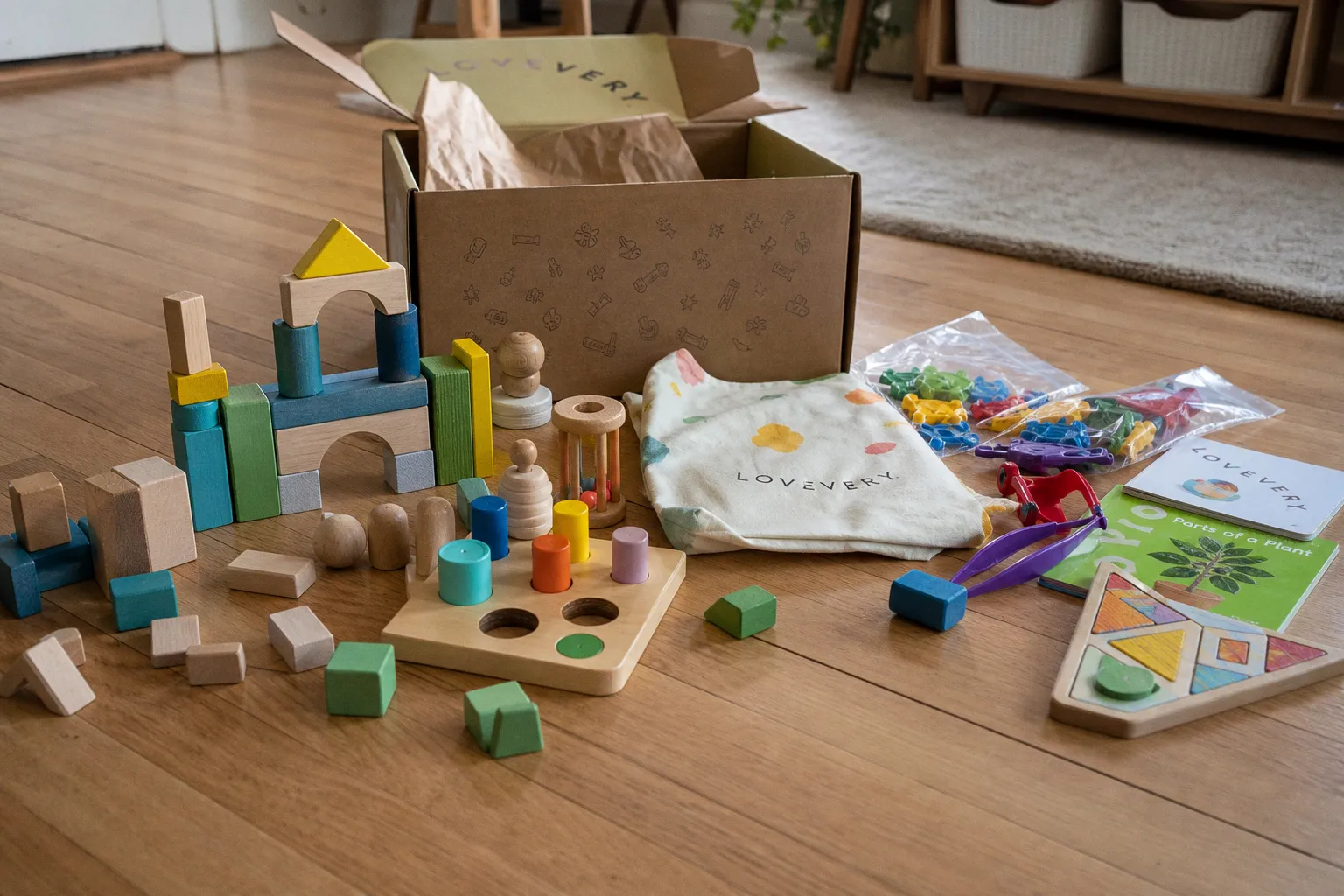
A toy subscription box is supposed to solve a very specific parenting problem: your child is bored with the same bin of plastic animals, you do not want to spend Saturday comparing “educational” claims on packaging, and you definitely do not want another noisy toy that eats batteries and attention spans at the same speed.
The promise is tidy: curated toys, shipped monthly or quarterly, matched to age and developmental stage. The reality is less tidy. Some boxes genuinely support toy rotation, fine motor practice, early STEM thinking, literacy, sensory play, or independent play. Others are a $40 envelope of craft foam, glitter, and parental labor wearing a lab-coat sticker.
The real value is toy rotation, not surprise
The best toy subscription services are not magic because they arrive in a branded box. They work when they reduce clutter and refresh a child’s play environment without dumping twenty new objects into the room.
Toy rotation is the useful part. Limiting the number of toys available at once can improve focus and play quality because the child is not constantly skimming the room for the next novelty hit. In a real household, this matters. Fewer choices usually means longer engagement, less dumping, and a better chance that a child actually uses the materials as intended.
A good toy rotation subscription should do three jobs:
1. Match the child’s developmental window. A 19-month-old and a 28-month-old are not interchangeable just because they both technically live in the “toddler” category.
2. Add one or two new skills, not twelve. Fine motor practice, object permanence, sorting, sequencing, balance, early coding logic, letter recognition — pick a lane.
3. Leave the house cleaner than a toy aisle panic-buy. If the box adds clutter without replacing anything, it has failed the parent, even if the toys are cute.
This is where age-specific customization matters. Reputable services often let parents customize by exact age, and for toddlers that may mean down to the month. That sounds fussy until you test the toys on the floor. A bead threading activity can be perfect for one child and a choking hazard or frustration machine for another. A stacking toy can be too simple at 3 and too hard at 14 months.
The strongest toy subscription box is not the one with the most pieces. It is the one your child uses for more than six minutes without turning the room into a clearance bin.
The weak boxes lean on novelty. The better ones understand pacing. They do not send five unrelated activities and call that enrichment. They send a small set of materials that can be used in multiple ways: sorting today, pretend play tomorrow, counting next week, container play until everyone in the house is tired of hearing blocks hit the floor.
Age curation: where boxes help, and where they get sloppy
The toy subscription box market now stretches from newborns to teenagers, roughly 0 months to 14+ years. That sounds convenient, but “kids” is too broad to mean anything. The needs of a baby mouthing every object are not in the same universe as a 10-year-old building a circuit or a 13-year-old testing chemistry reactions.
Here is the practical breakdown I use when judging whether an educational toy box is actually age-appropriate.
| Age range | What the box should prioritize | Watch for | Parent involvement |
|---|---|---|---|
| 0–12 months | Sensory exploration, grasping, visual tracking, safe mouthing materials | Small parts, overly complex “milestone” claims, hard corners | High supervision, always |
| 12–36 months | Fine motor skills, posting, stacking, early problem-solving, cause and effect | Choking hazards, frustration level, too many pieces | High to moderate supervision |
| 3–5 years | Pretend play, sorting, early literacy, counting, simple craft work | Mess factor, flimsy parts, adult-heavy instructions | Moderate supervision |
| 5–8 years | STEM basics, building, sequencing, observation, simple experiments | Projects that only work if an adult does everything | Moderate, then partial independence |
| 9–12 years | Deeper STEM kits, engineering challenges, coding logic, longer builds | One-and-done projects, weak instructions | Light to moderate supervision |
| 13+ years | Specialty interests: robotics, advanced craft, science kits, design challenges | Babyish branding, shallow “STEM” labeling | Varies by materials and tools |
For babies and toddlers, I am looking hard at material safety, size, edges, and whether the toy can survive being thrown, chewed, stepped on, and used incorrectly. Because it will be used incorrectly. That is not a flaw in the child. That is the testing protocol.
For preschoolers, the question changes. Can the child understand the activity without a parent narrating every step? Does it build fine motor skills without turning into a rage spiral? Can the pieces be stored without becoming permanent floor confetti?
For school-age children, I care less about “cute” and more about whether the project has a real learning arc. STEM-focused subscription boxes often target children around ages 5 to 12 and may align with NGSS or similar educational frameworks. Alignment is useful when it is real, but it is not enough by itself. A kit can name-drop engineering practices and still rely on a parent doing the build while the child decorates the final product.
The attention span test is blunt: after the first unboxing excitement wears off, does the child return to the item? A decent box gets repeat play. A good one gets repurposed. A great one quietly joins the regular toy rotation because it solves a play problem you already had.
STEM kits versus Montessori-inspired boxes
The two most common claims in this category are “STEM” and “Montessori-inspired.” Both can mean something. Both can also be sprayed onto marketing copy like air freshener.
STEM boxes usually work best for children who are old enough to follow a sequence, tolerate a failed attempt, and understand that a project may take more than three minutes before it does anything interesting. Many STEM kits sit in the 5-to-12 range for good reason. Children in that range can start connecting cause and effect, structure and outcome, prediction and result.
The better STEM kits include:
- Clear instructions with pictures that a child can follow. If the parent has to decode tiny diagrams while dinner burns, the kit is not as independent as advertised.
- Materials that match the experiment. A flimsy paper “robot” does not teach robotics just because it has googly eyes and a battery.
- A reason to test, adjust, and try again. The strongest STEM projects include a failure loop. Build the bridge, test the bridge, reinforce the bridge. That is learning. Assembling a pre-cut object once is just assembly.
- Safety boundaries that are visible. Magnets, wires, liquids, powders, sharp tools, and coin batteries change the supervision level immediately.
Montessori-inspired toddler boxes are a different animal. They often emphasize wooden toys, sensory development, practical-life skills, and fewer battery-operated distractions. I like that direction when it is done honestly. A simple wooden posting box, object permanence box, shape sorter, or nesting set can hold more developmental value than a loud toy with twelve modes and no clear purpose.
But “Montessori-inspired” does not automatically mean durable, safe, or developmentally precise. It can also mean beige. Beige is not a pedagogy.
Here is the working comparison.
| Category | Best for | Strong signs | Weak signs |
|---|---|---|---|
| STEM toy subscription | Ages 5–12, curious builders, kids who like experiments | Real build/test cycle, sturdy components, clear skill target | Parent does all hard steps, science reduced to decoration |
| Montessori-inspired box | Babies to preschoolers, sensory and fine motor development | Simple materials, open-ended play, exact age matching | Overpriced wooden objects with vague milestone language |
| Craft box for kids | Preschool through elementary | Contained materials, skill progression, manageable cleanup | Glitter explosion, single-use crafts, too much adult prep |
| Literacy or book box | Toddlers through older readers | Age-matched books, discussion prompts, repeat reading value | Random titles, poor reading-level fit, too many trinkets |
If your child is under 3, I would usually choose safe, open-ended materials over a project-based STEM box. If your child is 6 or older and likes building, tinkering, or asking why things break, STEM starts to make more sense. If your child hates instructions but loves experimenting, choose boxes with flexible engineering challenges rather than rigid crafts.
The price question: $20 to $60 is only the sticker
Most kids’ subscription boxes fall roughly in the $20 to $60 per box range, depending on delivery frequency and complexity. Monthly boxes create a steady rhythm but also a steady pile. Quarterly boxes can be better for families who already own too much and need slower intake.
The question is not “Is $35 expensive?” The question is “What would I otherwise buy, and would it be better?”
A $25 box with two durable toys that stay in rotation for months can beat a $60 box full of consumable activities that are finished by lunch. A $50 STEM kit can be fair if it includes real components, a satisfying build, and enough depth for repeat testing. A $20 craft box can be overpriced if half the contents are paper shapes you could cut yourself, assuming you have the willpower and scissors are not missing again.
I look at cost per usable play session, not cost per item. Tiny pieces inflate item counts. They do not inflate value.
A practical budget read:
- Under $25 per box: Expect simpler materials, paper-based activities, small crafts, books, or light toy rotation. Good value if the curation is sharp and the cleanup is low.
- $25–$40 per box: This is the most competitive range. You should expect age matching, decent materials, and at least one item or project with repeat use.
- $40–$60 per box: The box needs to justify itself with durable toys, richer STEM components, higher-quality books, or strong customization. At this price, filler is irritating.
- Quarterly premium boxes: These can work if each shipment replaces several impulse purchases. If it simply arrives larger, it may just create quarterly clutter.
Also check whether the subscription model allows skipping, pausing, or adjusting age levels easily. Children develop unevenly. A child may be advanced in language and still very much on schedule for fine motor skills. A rigid age band can miss that.
And please do not underestimate storage. A toy subscription service that sends beautiful materials with no clear storage plan becomes a parent-admin project. Bags, trays, labels, bins — the unglamorous infrastructure matters. If the kit has 38 pieces and no container, that is not neutral. That is future under-couch archaeology.
Durability testing: the unboxing is the least important part
Unboxing photos reward packaging. Children test engineering.
For a real review, I care about what happens after the first 48 hours. The first day is novelty. The second day is the start of truth. By the end of a week, you know whether the toy has become part of independent play or has migrated into the sad corner with missing puzzle pieces and abandoned craft sticks.
My durability checks are not fancy, because households are not fancy:
1. Drop test from child height. If a toddler toy cracks after a normal fall from table or couch height, it is not built for toddlers.
2. Mouth and wipe test for baby items. Anything for babies and young toddlers must tolerate drool, wiping, and repeated handling without peeling, splintering, or shedding mystery coating.
3. Step-on test for floor toys. Not a full adult stomp, but the ordinary “parent walking through chaos” pressure. Thin plastic fails fast.
4. Connector fatigue for STEM kits. Pieces that snap together should still hold after several builds. Loose connections destroy both play value and patience.
5. Cleanup timing. If cleanup takes longer than the play session, I count that against the box unless the learning value is unusually strong.
6. Repeat-use scan. Can the child use the item again in a different way, or is it done forever after one assembly?
A box that requires a calm table, a fully available adult, and a freshly mopped floor is not a bad box. It is just not an independent-play box, and parents deserve that distinction before paying.
The mess factor deserves its own line because brands love to blur it. “Hands-on” can mean meaningful sensory play. It can also mean dye on the table, beads in the vent, and a parent scraping glue from a chair at 9 p.m. Mess is not automatically bad. Some excellent sensory and craft boxes are messy. But the mess should serve the skill.
A finger-paint color-mixing activity? Fair. A packet of glitter for decoration with no developmental purpose? Absolutely not, unless the brand also ships a vacuum and a handwritten apology.
Educational claims need adult translation
“Educational” is one of the least regulated-feeling words in the toy aisle. It can mean child-led problem solving, early math language, phonemic awareness, engineering design, sensory integration, or “we printed numbers on it.”
When I evaluate an educational toy box, I translate the marketing claim into observable behavior.
If a box says it builds fine motor skills, I want to see pinching, threading, stacking, twisting, transferring, lacing, clipping, or controlled placement. If it says STEM, I want prediction, building, testing, measuring, or troubleshooting. If it says literacy, I want more than a book dropped into a box with stickers. Give me rhyme, sequencing, letter-sound work, vocabulary, comprehension prompts, or strong repeat-read value.
The more specific the skill, the easier it is to judge.
Vague claim: “Boosts brain development.”
Useful claim: “Practices bilateral coordination through lacing cards and bead transfer.”
Vague claim: “Encourages creativity.”
Useful claim: “Includes open-ended materials for building three different structures, then testing stability with weight.”
Vague claim: “Perfect for toddlers.”
Useful claim: “Designed for 18–24 months with large pieces, posting play, and no small detachable parts.”
No subscription box should be treated as a guaranteed academic booster. It will not raise IQ. It will not replace a responsive adult. It will not make a tired child suddenly love worksheets. The best boxes create better conditions for play: fewer but better materials, a manageable skill target, and enough novelty to re-engage attention.
That is plenty. It does not need to pretend to be a private tutor in cardboard form.
When a toy subscription box is worth it
A toy subscription box makes the most sense for families who want curation and are willing to be disciplined about rotation. If new boxes come in but old toys never leave the play space, the subscription becomes clutter with postage.
It is worth considering if:
- You have a child in a fast-changing developmental stage. Babies and toddlers can outgrow materials quickly, and age-matched boxes may reduce guesswork.
- You want structured activities but not a full homeschool curriculum. Many educational boxes sit nicely between free play and formal lessons.
- Your child benefits from novelty but gets overwhelmed by too many options. Rotation can give freshness without chaos.
- You are buying random toys too often. A subscription can be cheaper than repeated impulse purchases if you actually stop the impulse purchases.
- You want a predictable project rhythm. Monthly or quarterly delivery can be useful for weekends, school breaks, or homeschool enrichment.
It is less compelling if your child already has a strong toy rotation system, a stocked craft cabinet, and adults who enjoy planning projects. In that case, you may not need a subscription. You may just need to hide half the toys in a closet and bring them back later like they are new. This is not elegant, but it works.
For children under 3, I am strict about small parts and supervision. For preschoolers, I am strict about frustration level and cleanup. For elementary-age kids, I am strict about whether the child can do meaningful parts of the project. For older kids, I am strict about depth. Teenagers can smell a shallow kit from across the room.
My verdict: buy for curation, not miracles
The best toy subscription is the one that fits your child’s current stage, your tolerance for mess, and your actual availability as a parent. Not the version of you who lovingly supervises a 90-minute engineering build on a Wednesday. The real you. The one answering an email, reheating coffee, and asking why there is tape on the dog.
If you are choosing one broad category, I would start this way:
- Baby or young toddler: Montessori-inspired or sensory-focused toy rotation box with exact age matching, large pieces, and durable materials.
- Older toddler or preschooler: Open-ended play box with fine motor practice, pretend play, sorting, and low-to-moderate mess.
- Early elementary child: STEM or craft box with clear instructions and enough independence to avoid becoming parent homework.
- Upper elementary child: Stronger STEM kits, engineering challenges, coding logic, science experiments, or specialty boxes tied to a real interest.
- Mixed-age household: Choose durability and open-ended materials over narrow age claims. Shared play beats a perfect box that only works for one child while everyone else grabs the pieces.
The key caveat is supervision. No box replaces it, especially with toddlers, small parts, magnets, liquids, tools, or anything that looks even remotely edible to a determined child. The marketing may show peaceful independent play. The household version may require an adult within arm’s reach and a broom nearby.
A toy subscription box can be worth the fee when it brings better rotation, better materials, and better-targeted play into the house. It is not worth it when it sells educational language without durable design, sends too many one-and-done activities, or quietly transfers all the labor to the parent.
My strict read: subscribe only if the box reduces decision fatigue without increasing cleanup fatigue. If it does both, keep it. If it only adds cardboard, parts, and guilt, cancel before the next cheerful shipment arrives.
FAQ
How do I know if a toy subscription box is age-appropriate?
Are STEM subscription boxes suitable for all children?
What should I look for in a Montessori-inspired box?
How can I tell if a subscription box is overpriced?
Should I choose a monthly or quarterly subscription?
 Kids & Education BoxesMatch Children's Book Clubs to Your Kid's Reading Level
 Kids & Education BoxesKids subscription box guide: what to buy and what to skip
 Beauty & Fashion BoxesCompare Clean Beauty Boxes Under $40 for Sensitive Skin
 I’m a beauty editor — these 41+ Prime Day beauty deals are actually worth it