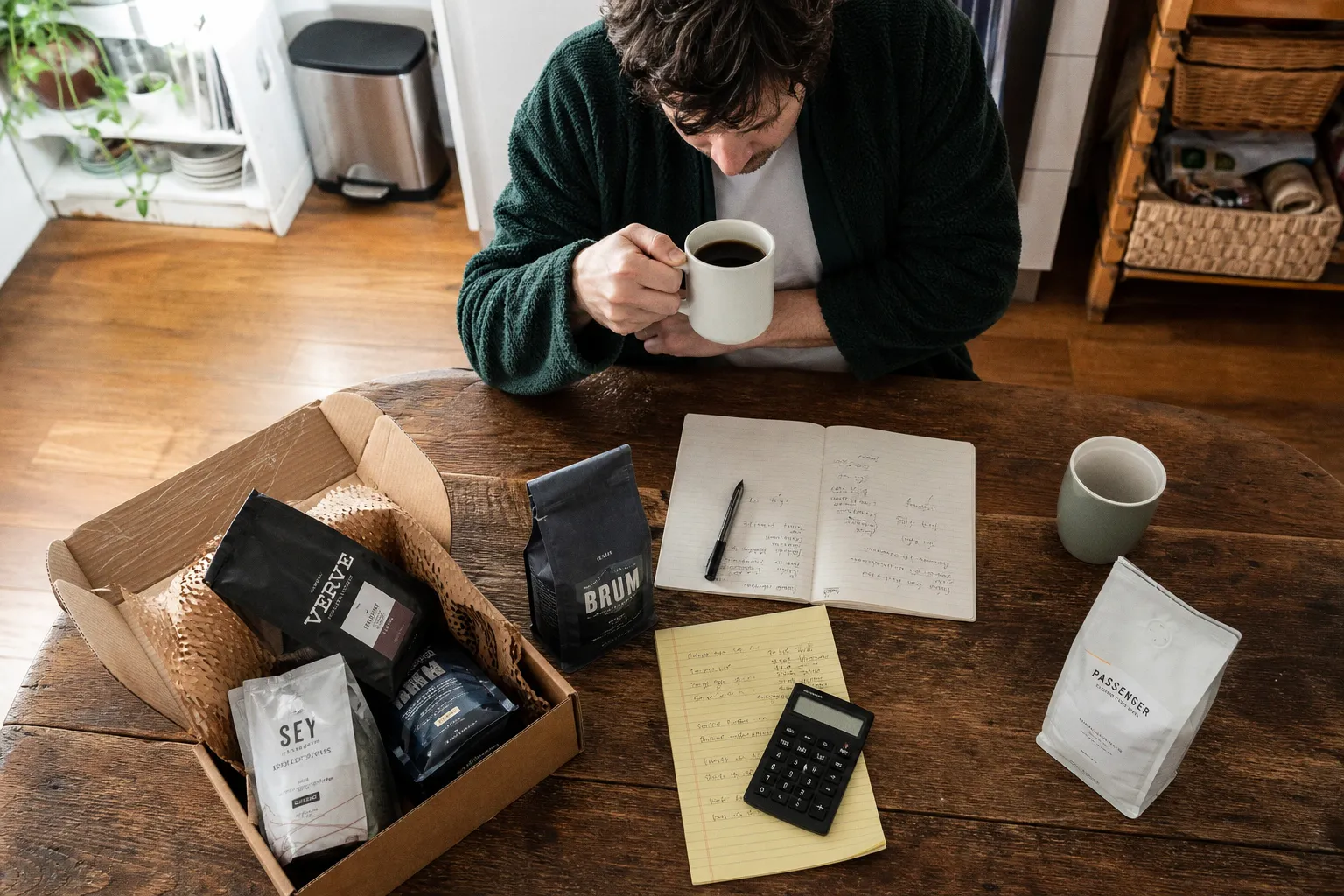
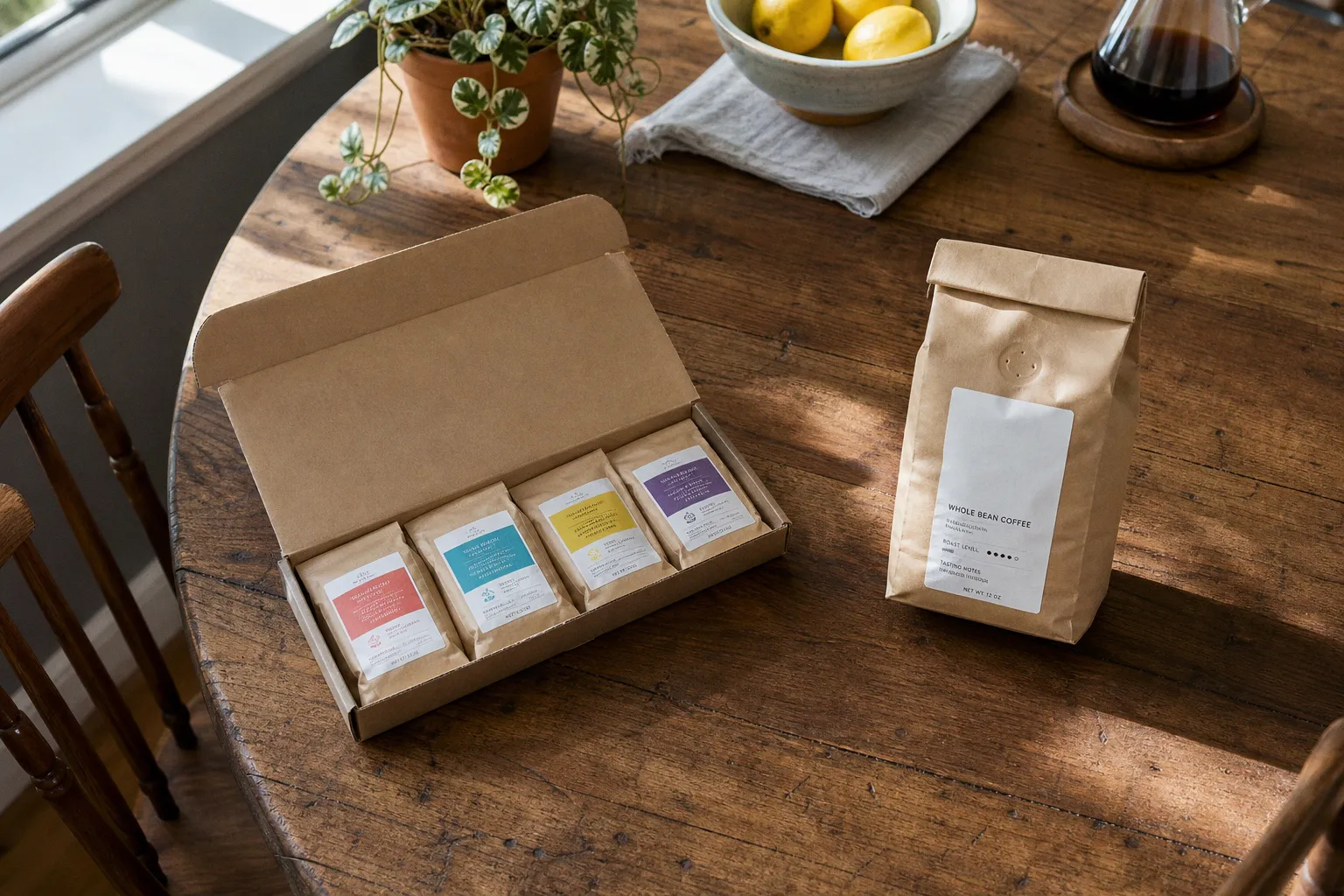
Trade Coffee Subscription: What to Buy and Key Caveats
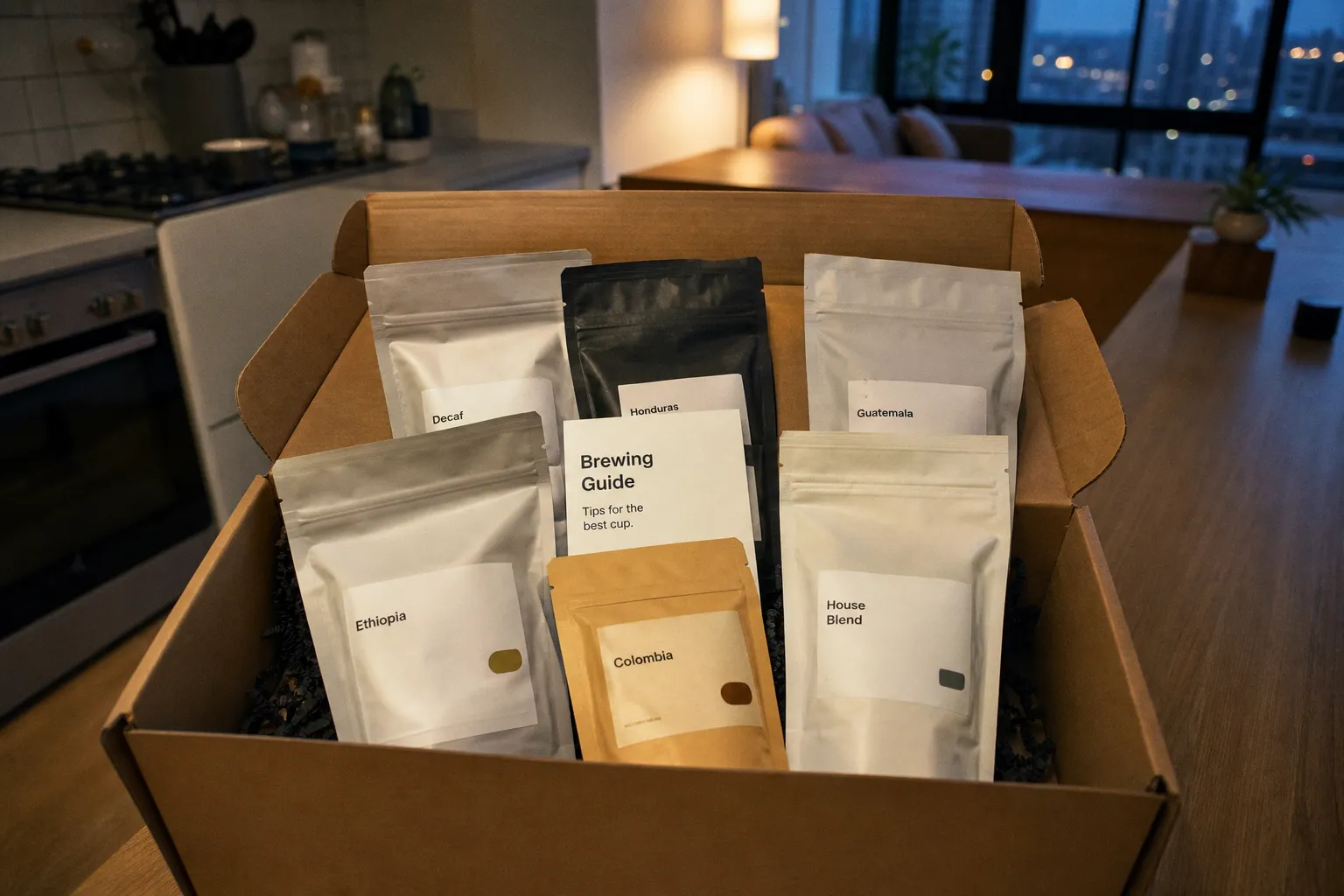
The core promise is straightforward: answer a taste quiz, receive coffee matched to your preferences, and move through a catalog of more than 450 coffees from 55-plus U.S. roasters without signing up separately with each one.
That is a useful service. It is not magic, and it is not the cheapest path to good beans. Trade is a middleman, not a roaster. The value is in discovery, convenience, and a fairly broad tasting lane; the friction shows up when your household coffee routine is less tidy than one person drinking one kind of coffee every morning.
My short version after looking at the tiers, bag sizes, guarantee, and subscription controls: Trade is worth trying if you want fresh-roasted variety and can commit to a clear preference profile. It is less appealing for split-caffeine households, people who want total control over every shipment, or anyone who treats prepaid subscriptions as “set it and forget it.”
The middleman model: access is the product
Trade Coffee does not roast its own beans. That distinction matters because some of the marketing language around coffee subscriptions can make a platform feel like a singular coffee brand with a single point of quality control. Trade’s job is different: it connects subscribers to a network of independent craft roasters and uses its matching system to narrow the options.
The catalog covers more than 450 coffees, with partners numbering over 55 roasters. That breadth is the reason to consider a Trade Coffee subscription in the first place.
A local roaster subscription can be excellent, but it generally asks you to trust one roasting style and one sourcing philosophy. Trade offers more movement. You can start with an approachable chocolate-forward blend, then move toward a washed Ethiopian or a lightly roasted single-origin without rebuilding your subscription from scratch. For a drinker trying to identify what they actually like, that is productive exposure rather than random novelty.
The practical question is whether the matching system gets you into the right neighborhood. It will not replace the feedback loop of speaking directly with a skilled café barista or a roaster. But it can reduce decision fatigue, which is a real problem when the alternative is opening twenty coffee tabs at 10:45 p.m. and buying nothing.
Trade’s quiz and ratings system work best when you are honest about the equipment and cup you want. “I like coffee” is not a useful preference profile. The relevant details are much more specific:
- Brew method: A dark roast that holds up in a drip machine may be dull or harsh in a precision pourover. Espresso drinkers should not treat “bold” as a complete instruction.
- Flavor tolerance: If you dislike acidity, do not select fruit-forward tasting notes because they sound sophisticated. You are signing yourself up for coffee that may sit untouched after two morning cups.
- Roast preference: Medium and dark roasts are not a failure of palate development. They are often exactly right for milk drinks, automatic machines, and rushed weekday brewing.
- Whole bean versus ground: Whole bean is the better default if you own a grinder. Ground coffee removes a step, but it also reduces the freshness window and leaves less room to adapt the grind to your brewer.
- Consumption pace: An 11-ounce bag is not a minor detail. It determines whether coffee arrives while you are still finishing the prior bag or whether your kitchen turns into a stale-bean storage unit.
This is the coffee equivalent of assessing a toy’s actual independent-play value rather than admiring the box art. The selection is impressive. The useful selection is the subset you will brew before it goes flat.
Trade’s catalog is broad enough to teach you your preferences. It cannot make vague preferences precise for you.
Decoding the pricing tiers: Classics versus Premium
Trade divides its subscription selection into two primary tiers: Classics and Premium. The labels are reasonably descriptive, though neither says much about whether a specific coffee suits your brewer or taste.
Classics focuses on more approachable coffees, including blends and medium-to-dark roast profiles. Premium is where Trade places single-origin selections, lighter roasts, and coffees with more experimental processing. That division is sensible for browsing, but it should not be mistaken for a simple quality ladder. A well-developed, balanced Classic can be a much better daily coffee than a Premium light roast that clashes with your water, grinder, or preferred milk ratio.
Here is the pricing structure in a form that makes the decision easier.
| Parameter | Classics | Premium |
|---|---|---|
| Standard bag price | $16.99 | $21.99 |
| Standard bag size | About 11 oz / 310 g | About 11 oz / 310 g |
| Two-pound bag price | $39.99 | $49.99 |
| Typical profile | Blends; medium and dark roasts | Single origins; light roasts; experimental processes |
| Best fit | Daily drip coffee, espresso, milk drinks, familiar flavor profiles | Curious drinkers, black-coffee drinkers, people seeking more distinct origins and processing styles |
The standard-bag price is where the Trade Coffee review becomes less rosy than the landing page. At $16.99 for roughly 11 ounces, Classics is not a bargain-bin daily driver. Premium at $21.99 per 11-ounce bag is a clear premium purchase. The service can still be worth it, but the value calculation should include freshness, discovery, and the ability to access roasters you might not otherwise encounter—not just the sticker price.
The two-pound options improve the per-ounce math, especially if you already know what works in your household. But larger bags have a freshness tradeoff. Unless you go through coffee quickly, divide the beans into smaller airtight portions or freeze what you will not use soon. A two-pound bag is efficient only if it does not become a long-term countertop resident.
There is also a historical bag-size issue worth stating plainly. Subscribers have reported unannounced reductions from 12 ounces to approximately 11 ounces while prices stayed level or rose slightly. The current standard size is about 11 ounces, and that is the number to use when comparing Trade with a local subscription or another national service. Do not compare by “one bag.” Compare the actual weight, price, shipping terms at checkout, and how quickly your household drinks coffee.
For many people, Classics is the smarter starting point. It has lower financial risk, tends to offer more forgiving coffee for automatic drip makers and espresso machines, and creates less of a mess factor if a match is merely fine rather than thrilling. Premium is best once you know you enjoy lighter, more origin-specific coffees—or when your brewing setup is capable of showing their detail.
What counts as the best Trade coffee beans?
There is no single “best” bag because the answer changes with your brew method and tolerance for brightness. But there are useful categories:
1. For the conventional morning coffee drinker: Start in Classics with a medium or medium-dark blend. These are generally more stable choices for drip machines, batch brewers, and households where coffee needs to taste good before anyone has had a chance to think.
2. For espresso with milk: Look for chocolate, caramel, nut, or baking-spice profiles, often in medium-to-dark territory. Very light Premium coffees can work in espresso, but they demand more dialing in and can create a frustrating morning before school drop-off.
3. For black coffee and pourover: Premium is where Trade’s network can be most interesting. Single origins and lighter roasts give more clarity, but only if you enjoy citrus, florals, berry notes, or tea-like body.
4. For a shared kitchen: Choose the coffee the primary brewer can make reliably. A technically fascinating bag that needs repeated grinder adjustments has low household usability, regardless of cupping-score implications.
5. For gifting: A Trade subscription is a better gift for someone who enjoys trying different roasters than for someone loyal to one dark roast. The discovery mechanism is the present.
The service benefits from a simple tasting tracker. Nothing elaborate: note the roast level, brewer, whether you drank it black or with milk, and whether you would reorder it. After three or four bags, this produces more useful feedback than choosing flavor notes by aspiration.
The First Match Guarantee is useful, but narrow
Trade offers a First Match Guarantee: if you do not like the initial recommended bag, the company will replace it for free when you contact customer support within one week.
This is a legitimate risk reducer for a first order. Coffee matching is imperfect, and a first bag is where the system has the least information. A replacement lets you correct an obvious mismatch without paying twice for the platform’s guess.
But read the boundaries correctly. The guarantee applies to the first bag, not every coffee you later decide was not your thing. The one-week window is also short enough that passive testing will not work. If you wait until the bag is nearly gone, or leave it unopened because the previous bag is still in rotation, you may miss the window entirely.
Treat the first delivery like a quick fit test:
- Brew it using the method you told Trade you use.
- Try it at least twice, ideally with a modest adjustment to grind or ratio if your setup allows.
- Decide whether the issue is brewing or a fundamental flavor mismatch.
- Contact support within the first week if the coffee is clearly wrong for you.
That is not overthinking it. It is the same distinction parents make between a toy that needs one battery replacement and a toy that is structurally annoying. A little setup is normal; a fundamental mismatch is not.
The First Match Guarantee protects the first experiment, not an unlimited sequence of changed minds.
Customer support becomes especially relevant because Trade’s catalog is large. The algorithm may move you through reasonable options, but a clear note—“I need low-acid coffee for drip, no smoky dark roasts, and I drink it with oat milk”—is often more actionable than star ratings alone.
The friction points: renewals, bag size, and the fine print around convenience
Subscriptions are convenient right up until they are not. Trade’s core offering works best when you actively manage it: check your upcoming shipment, update your frequency as consumption changes, and monitor prepaid orders.
The most serious caveat in user reports concerns automatic renewal on prepaid bundles. Some subscribers have reported being charged when a prepaid plan renewed without notification, along with difficulty removing payment details from the website. That does not mean every subscriber will have the same experience, and it does not establish that the issue is unresolved today. It does mean a prepaid Trade Coffee subscription should be treated as a recurring financial commitment, not as a one-time gift card with a tidy endpoint.
The no-nonsense approach is simple:
- Put the renewal date on your calendar the day you purchase a prepaid plan.
- Review the account settings before the final prepaid shipment arrives, not after.
- Keep order confirmations and payment records until you are certain the subscription status is what you intended.
- If you are gifting a plan, explain whether it renews automatically. “Surprise, more coffee” is only charming when the recipient chose it.
Bag weight deserves similar attention because coffee subscriptions make it easy to think in shipments rather than ounces. A standard bag is currently about 11 ounces, or 310 grams. If your routine is two large mugs per day for two adults, that may disappear fast. If you alternate coffee with tea, cold brew, or office coffee, one bag can linger longer than expected.
The right delivery cadence is not the one that feels optimistically coffee-person-ish. It is the one that matches actual consumption. Start a little slower, then adjust after the first two bags. Coffee is perishable enough that stockpiling makes no sense, but a gap that sends you back to emergency grocery-store beans is not efficient either.
The decaf dilemma: customization has a hard limit
Trade has a meaningful customization problem for households with mixed caffeine needs: subscribers have reported that there is no easy, obvious way to combine regular and decaf bags within one standard subscription.
For a solo caffeine drinker, this may not matter. For a household where one person drinks regular in the morning and another needs decaf—or where the same person switches after noon—it is a real limitation. The subscription format assumes a relatively consistent coffee identity. Real kitchens are rarely that tidy.
This is where Trade can feel less flexible than its giant catalog suggests. You may be able to find excellent decaf coffee through the broader service, but the workflow of mixing decaf and regular shipments is not as smooth as it should be. That adds admin: separate orders, separate schedules, or more manual selection.
If decaf is central to your routine, do not assume the quiz will solve it. Check the current subscription configuration before committing, and be prepared to maintain two distinct tracks if needed. The added friction may be acceptable if you value access to independent roasters. It may also be the reason you choose a simpler roaster-direct subscription instead.
This is the point where a comparison such as Trade Coffee vs. Bean Box becomes less about which service has “better coffee” and more about what kind of chooser you are. Trade’s strength is its large, curated network and personalized matching. A smaller discovery service may feel more coherent if you want a more contained tasting experience. A direct-roaster subscription is better if you already know whose coffee you want. None of those models wins universally.
Is a Trade Coffee subscription worth it?
Yes, with a specific use case. Trade is worth the subscription fee for a coffee drinker who wants access to many independent U.S. roasters, appreciates fresh roasted-to-order beans, and is willing to give useful feedback after each bag. The Classics tier is the sensible entry point for most households. It costs less, offers more forgiving profiles, and is better suited to daily brewing equipment that needs coffee to work without a science project.
Premium is worth the extra cost if you are deliberately exploring light roasts, single origins, and more unusual processing methods—and if you have the grinder, brewing habits, and patience to make those coffees show up properly.
I would not recommend Trade as a hands-off subscription for a mixed decaf-and-regular household, for someone who gets irritated by account-management chores, or for a buyer who needs every shipment to be a predictable 12-ounce value play. The catalog is the attraction; the subscription mechanics require supervision.
The best outcome is not finding one universally perfect Trade bag. It is using the first few shipments to build a reliable personal shortlist: a weekday workhorse, a better weekend coffee, and perhaps one adventurous option that earns its place. If the service helps you do that without creating stale inventory, surprise renewals, or a cabinet full of coffee nobody wants to finish, it has done its job.