Bean Box Coffee Subscription: Sampler vs. Whole Bag
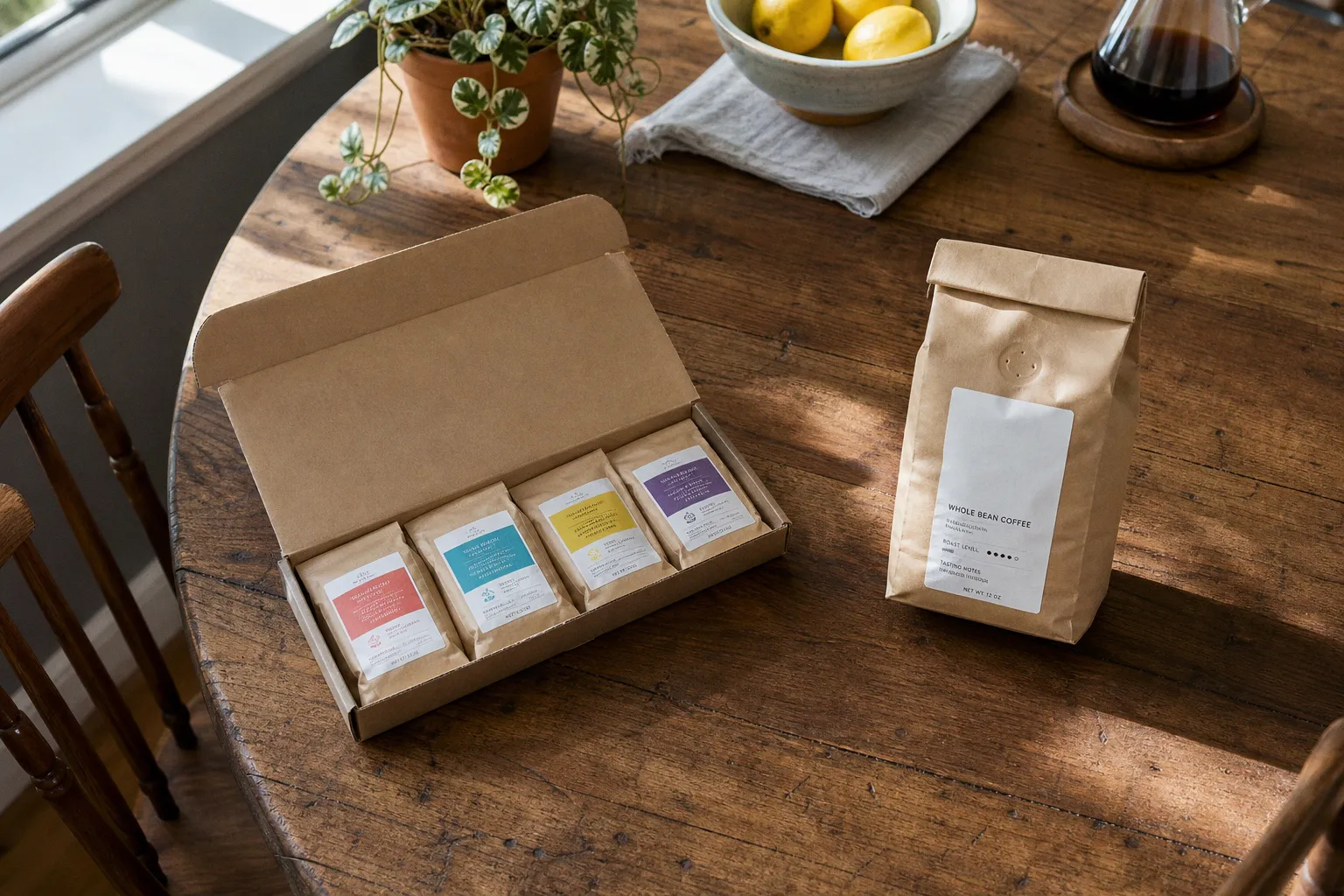
That does not automatically make the Sampler a bad buy. It does make the math non-negotiable. The Sampler sells variety. The Coffee Bag sells usable volume. If you drink coffee daily, those are not interchangeable benefits.
Bean Box’s core promise is straightforward: coffee from independent roasters, shipped within 48 hours of roasting, with options for roast profile and grind. The part that needs scrutiny is not freshness. It is whether you are paying for exploration or paying for breakfast.
The Philosophy of Coffee Curation: How Bean Box Works
Bean Box is a curator, not a roaster. That distinction matters. The company sources coffee from independent roasters in Seattle and other regions across the United States, then packages the subscription experience around discovery, freshness, and preference matching.
The useful part: Bean Box lets subscribers choose roast profile and grind type. Roast options include Light, Medium, Dark, Espresso, and Decaf. Grind options include Whole Bean and Ground. That covers the basic operational requirements for most home brewers.
The risk: curation often becomes a surcharge category. The box company adds value only if it improves selection, access, freshness, or fit. Otherwise, it is just a middle layer between you and a roaster.
Bean Box has one hard advantage here: the coffee is guaranteed to ship within 48 hours of roasting. For coffee, that is not decorative language. Freshness has measurable utility. Roasted coffee starts losing volatile aromatics quickly after roasting, and stale coffee is a depreciation problem. You can still brew it. You just cannot recover the compounds that already left the bag.
The two plans split the value proposition cleanly:
| Parameter | Coffee Sampler | Coffee Bag |
|---|---|---|
| Shipment format | Four small bags | One full-size bag |
| Total coffee | 7.2 oz | 12 oz |
| Per-bag size | 1.8 oz | 12 oz |
| Main value | Variety and comparison | Daily brewing volume |
| Best use | Testing roasters and roast profiles | Replenishing a household coffee supply |
| Main liability | Less coffee per shipment | Less variety per shipment |
| Waste risk | Low if you dislike one coffee | Higher if the whole bag misses |
| Friction | More bags to track and dial in | One coffee, one brew adjustment |
This is the actual comparison. Not “which is more fun.” Not “which feels more premium.” Ounces, use case, and waste exposure.
The Sampler is not a miniature version of the Coffee Bag. It is a paid tasting flight with a lower coffee yield.
Exploring the Coffee Sampler: Variety With a Real Volume Penalty
The Bean Box Coffee Sampler includes four 1.8 oz bags. Total coffee: about 7.2 oz.
That format is built for comparison. You get multiple coffees in one shipment, usually enough of each to run a few brews depending on your method and dose. It is useful if you are trying to learn what you like. It is less useful if you already know.
A standard 1.8 oz bag equals roughly 51 grams of coffee. That is not much. If you brew pour-over at 16 grams per cup, one sample gives you about three cups. If you brew stronger or larger, the count drops. If you use a 30-gram dose for a bigger batch, one sample barely covers one full brew and a correction attempt.
That matters because coffee has a setup cost. You often need one brew to dial grind size, ratio, and extraction. A small bag compresses the testing window. If the first cup is sour because the grind was too coarse, part of the sample is already consumed before you have judged the coffee properly.
The Sampler works best when the buyer accepts that trade. This is not a stock-up plan. It is a data-gathering plan.
The defensible reasons to choose the Sampler:
1. You are mapping preferences, not filling a canister.
Light versus medium. Washed versus natural processing. Chocolate-heavy profile versus fruit-forward profile. The Sampler gives you more comparison points per shipment than a full bag.
2. You do not trust a single-roaster commitment yet.
A 12 oz bag of the wrong coffee is a long week. Four 1.8 oz bags cap the downside. Bad fit becomes a small write-off, not inventory.
3. You brew occasionally.
If you drink coffee a few times per week, a 12 oz bag can sit too long after opening. Smaller bags may preserve freshness better in actual use, even though the total value per ounce is weaker.
4. You are buying for education.
If the purpose is palate training, the Sampler has real utility. Comparison is how people learn. One bag per month teaches less.
5. You want lower repeat exposure.
Subscription fatigue is real. Variety delays it. That has value, but it is not the same as coffee volume.
The weak point is cost-per-ounce. Bean Box pricing changes with promotions and plan terms, so I am not going to invent a current monthly rate. But the weight difference is fixed in the available plan structure: 7.2 oz versus 12 oz. Unless the Sampler is priced sharply below the Coffee Bag, the per-ounce math will usually be worse.
The Sampler also creates more brew variability. Four coffees means four extractions. If you use a blade grinder, pre-ground coffee, or a basic drip machine, you may not extract enough difference to justify the tasting format. The more control your brewing setup gives you, the more useful the Sampler becomes.
That is the uncomfortable truth. A discovery box assumes you can detect and use the discovery.
The Coffee Bag Subscription: Better for Daily Consumption
The Coffee Bag subscription sends one 12 oz bag. That is the standard full-size format used by many specialty coffee roasters. It is also the cleaner economic product for most households.
A 12 oz bag is about 340 grams. At 17 grams per cup, that is around 20 cups. At 20 grams per cup, it is 17 cups. At 30 grams for a larger brewer batch, it is about 11 brews. This is the first plan that behaves like a practical coffee supply.
The full bag has fewer moving parts. You open one coffee. You adjust your grind once. You learn the coffee over several brews. That matters. Coffee improves when you stop treating each cup as a first attempt.
From a value analyst’s view, the Coffee Bag has three structural advantages:
- Lower packaging inefficiency. One 12 oz bag carries less packaging overhead per ounce than four tiny bags.
- Better brew calibration. More coffee means more chances to correct grind, dose, water temperature, and ratio.
- Higher usable volume. This is the core point. You get 12 oz instead of 7.2 oz.
The main liability is concentration risk. If the selected coffee does not match your taste, the entire shipment underperforms. A dark roast subscriber who receives something roastier than expected may be stuck with a bitter bag. A light roast subscriber who dislikes acidity may face the same problem from the other side.
Bean Box reduces that risk with roast-profile preferences. It does not eliminate it. “Medium” is not a standardized technical spec across roasters. One roaster’s medium can drink closer to light. Another can push toward dark. This is common in specialty coffee, and it makes preference matching imperfect.
Still, for daily drinkers, the Coffee Bag is the better default. It aligns with how coffee is consumed. One bag. Known volume. Fewer half-empty packets. Less novelty tax.
If you drink coffee every morning, the 12 oz bag is the base case. The Sampler has to justify its lower yield.
Bean Box Sampler vs. Bag: The Actual Buying Math
The clean comparison is not “variety versus consistency.” That is too soft. The correct comparison is yield, risk, and use.
| Decision Factor | Choose the Sampler if… | Choose the Coffee Bag if… |
|---|---|---|
| Consumption rate | You brew a few cups per week | You brew most days |
| Main goal | Find new roasters and styles | Keep fresh coffee on hand |
| Tolerance for repetition | Low | Moderate to high |
| Tolerance for mismatch | You want small downside per coffee | You accept one full-bag risk |
| Brewing setup | You can compare coffees side by side | You want to dial in one coffee |
| Value sensitivity | You accept paying for curation | You care more about ounces |
| Best buyer stage | Early preference discovery | Known preference maintenance |
The Sampler is a research expense. The Coffee Bag is an inventory purchase.
That framing solves most of the confusion. If a buyer is still learning whether they prefer light, medium, dark, espresso-style, or decaf subscriptions, the Sampler can be a rational first step. If the buyer already knows they want medium roast whole bean for an automatic drip machine, the Sampler becomes less efficient.
There is also the issue of plan switching. A smart use of Bean Box is to start with the Sampler for one or two cycles, collect preference data, then move to the Coffee Bag. Staying on the Sampler indefinitely only makes sense if variety is the product you are buying.
For gifting, the Sampler is stronger. Gift coffee has a high mismatch risk. Smaller bags reduce the penalty. The recipient also gets more visible variety, which improves perceived utility even when the actual coffee weight is lower. That is not irrational. It is a different transaction.
For a personal subscription, I would not treat perceived variety as enough. The question is whether the extra roaster exposure changes what you buy next. If not, it is filler value. Nice to open. Weak on repeat utility.
Customization Options: Roast Profile and Grind Are Useful, but Not Magic
Bean Box lets subscribers select roast profile: Light, Medium, Dark, Espresso, or Decaf. It also offers Whole Bean or Ground.
These are the correct controls. They are also broad controls.
Roast profile
Roast profile is the most important preference setting. It affects acidity, bitterness, body, and the way origin characteristics show up in the cup. But the labels do not behave like fixed manufacturing tolerances.
Light roast usually preserves more origin character and acidity. Medium roast tends to sit in the safer middle for drip and pour-over. Dark roast pushes toward heavier body and roast-derived bitterness. Espresso is not necessarily a roast level in strict terms, but in subscriptions it usually signals coffee selected or roasted for espresso brewing. Decaf is a separate functional category.
The practical issue: if your taste preference is narrow, these categories may not be narrow enough. “Medium” does not tell Bean Box whether you want caramel, citrus, cocoa, low acidity, high sweetness, or a dense body. The subscription may learn over time if the interface supports feedback, but the base choices are still coarse.
Grind type
Whole Bean is the better option if you own a burr grinder. It slows quality loss and lets you adjust grind size by brew method. Ground is more convenient but depreciates faster after grinding. That is physics, not snobbery. More exposed surface area means faster aroma loss and oxidation.
If you use pre-ground coffee because you do not own a grinder, the subscription can still be useful. The 48-hour post-roast shipping window helps. But ground coffee has a shorter quality runway once processed. A Sampler with ground coffee may be convenient, yet the tiny bags make dial-in difficult. A full bag of ground coffee is simpler but less flexible if the grind size is not ideal for your brewer.
My default recommendations:
- Whole Bean + Coffee Bag for anyone with a burr grinder and daily coffee use.
- Whole Bean + Sampler for people testing roast profiles or roasters.
- Ground + Coffee Bag for convenience buyers with a consistent drip machine.
- Ground + Sampler only if variety matters more than extraction control.
That last one is the weakest technical fit. A tasting sampler works best when the brewer can make fair comparisons. Pre-ground coffee limits adjustment.
Freshness Standards and Independent Roasters
The strongest operational claim from Bean Box is that coffee ships within 48 hours of roasting. This is the kind of claim that matters in coffee subscriptions because freshness is not an aesthetic preference. It is a product condition.
A grocery shelf bag may have an unknown roast date or a long lag between roasting and purchase. A roaster-direct subscription can be excellent, but it limits you to one roaster unless you manage multiple orders. Bean Box sits between those two models: fresher and more curated than most grocery coffee, broader than one roaster’s subscription.
The company sources from independent roasters in Seattle and across the United States. That sourcing model is the point of the service. Bean Box is selling access and selection, not its own roasting skill.
That has two consequences.
First, the roaster roster can change. Do not subscribe because you assume one specific partner will appear every month. That is not the product. The product is rotating curation within your selected preferences.
Second, sourcing claims should not be inflated. Bean Box should not be treated as automatically organic, fair trade, direct trade, or anything else unless a specific coffee carries that claim. Independent roaster sourcing is not the same as a universal sourcing certification.
For buyers who care about certifications, the Coffee Bag may be easier to evaluate than the Sampler. One full-size bag usually gives more room for origin details, processing notes, and roaster information. Four small bags may still provide key data, but the format is compressed.
Freshness also interacts with quantity. A 12 oz bag is only better if you can use it before quality drops. If you drink one cup every few days, the Sampler may waste less quality despite having a worse ounce count. If you drink daily, the full bag’s freshness window is practical.
The Best Bean Box Plan by Buyer Type
There is no universal best Bean Box plan. There is a best plan for a consumption pattern.
Best for daily drinkers: Coffee Bag
The Coffee Bag is the rational default. It sends 12 oz. It supports routine brewing. It gives enough coffee to dial in extraction. It carries less packaging friction. It is the better inventory product.
If you brew every morning, start here unless you have a strong reason to prioritize variety.
Best for beginners: Sampler, then switch
The Sampler is useful for the first phase of preference discovery. Use it to learn whether you prefer light, medium, dark, espresso, or decaf-oriented selections. Use it to identify roasters and flavor ranges. Then stop paying the small-bag premium unless discovery remains the main goal.
The mistake is treating the Sampler as a permanent household coffee plan. It can be. But only for low-volume drinkers or variety-first buyers.
Best for gifts: Sampler
The Sampler is the safer gift. Four coffees create more chances that at least one lands. The smaller bags reduce the risk of leaving someone with 12 oz of coffee they dislike. Gift value is not pure ounce value. It includes breadth.
Still, do not confuse that with maximum coffee value. The Coffee Bag wins on usable volume.
Best for espresso users: Depends on equipment
If the subscriber pulls espresso at home, the choice gets stricter. Espresso dialing consumes coffee. A 1.8 oz sample can disappear quickly while adjusting grind and yield. For actual espresso work, the Coffee Bag is usually more practical.
The Sampler can still help identify espresso-friendly coffees, but it is a poor format for repeated dialing. One or two bad shots can burn too much of the sample.
Best for decaf drinkers: Coffee Bag if the match is good
Decaf options are often narrower in specialty coffee subscriptions. If Bean Box’s decaf selection matches your taste, the full bag is likely the better plan. If you are uncertain, the Sampler may be worth one cycle, but long-term decaf buyers usually need consistency more than novelty.
Where Bean Box Beats Buying Direct—and Where It Does Not
Buying direct from a roaster can produce excellent value. You may get more control, more origin detail, and a direct relationship with the company roasting the coffee. If you already have a favorite roaster, Bean Box may be redundant.
Bean Box earns its fee when it reduces search cost. That means the buyer does not want to browse roaster sites, compare roast dates, gamble on unfamiliar bags, or manage multiple orders. The subscription centralizes that work.
That has value. But it should be priced as service value, not coffee value. The coffee itself still has to clear the basic math: total ounces, freshness, roast fit, and actual use.
The Sampler has the highest service component. Most of what you buy is selection. The Coffee Bag has a stronger commodity component. More of what you buy is drinkable coffee.
This is why the Coffee Bag is easier to defend for repeat use. It is not trying to make tiny bags look like a pantry solution. It is a pantry solution.
Verdict: Buy the Coffee Bag, Use the Sampler Strategically
For most subscribers, the best Bean Box plan is the Coffee Bag. It delivers 12 oz of freshly roasted coffee, supports daily brewing, and has better practical utility than four 1.8 oz samples. It is the plan that behaves like a real coffee subscription rather than a tasting kit.
The Sampler is not a bad product. It is just narrower than its marketing glow suggests. It makes sense for gifts, low-volume drinkers, and buyers still mapping their preferences. It is also a reasonable short-term diagnostic tool before moving to a full bag.
My verdict:
- Buy the Coffee Bag if you drink coffee most days or care about cost-per-ounce.
- Buy the Sampler if discovery is the point and lower total volume is acceptable.
- Wait for a promo code if you want the Sampler as a recurring subscription, because 7.2 oz needs a discount to compete as coffee supply.
Bean Box’s freshness standard and independent-roaster model are credible reasons to consider the service. But the subscription choice is not complicated. If you need coffee, buy the bag. If you need information, buy the Sampler.