Baby toy subscription brands compared for safety and value
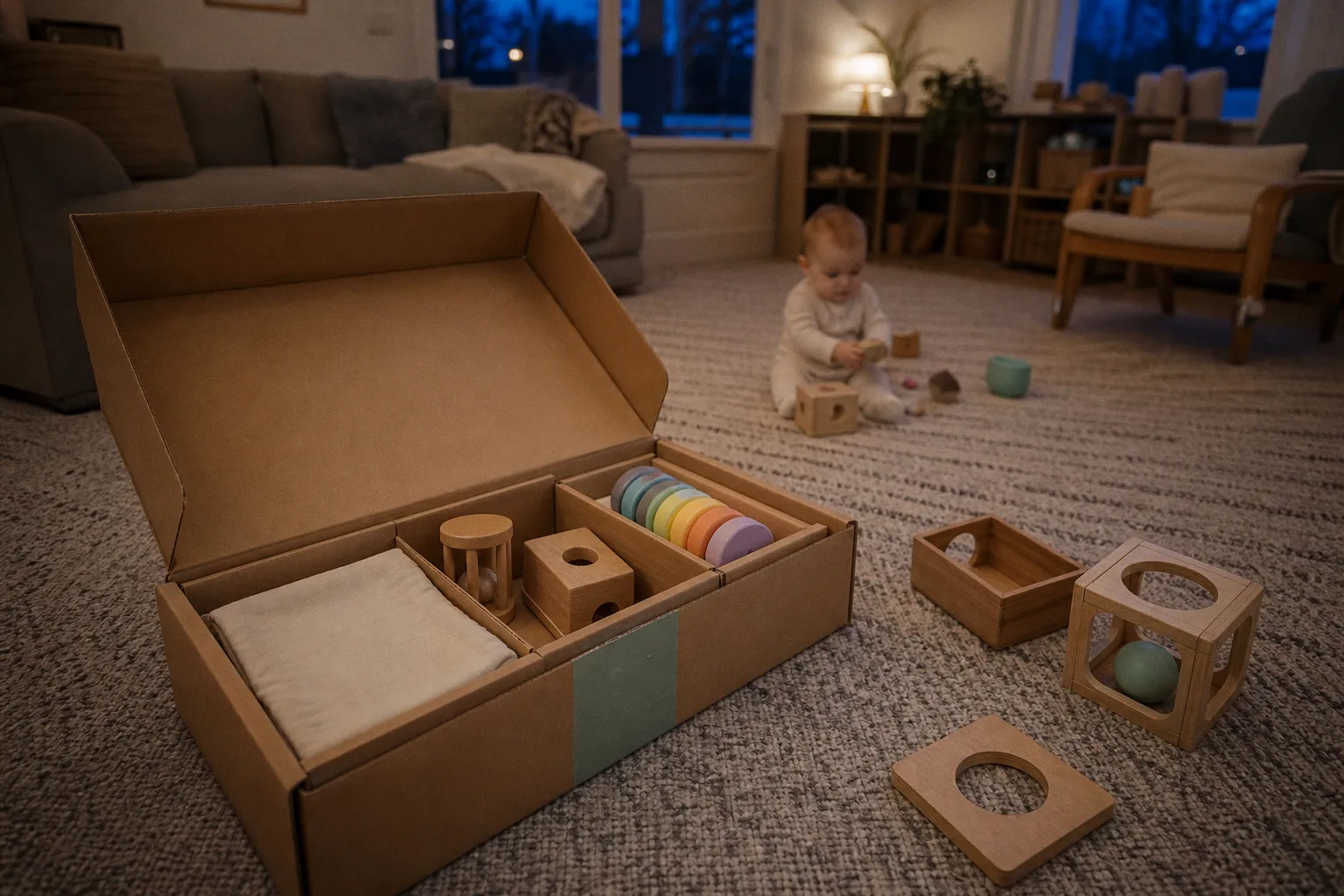
That is the real comparison point before tax, shipping terms, price changes, and promotions.
The retail-value problem is less clean. Neither program can be judged by a single “value of items inside” number without current, crate-by-crate retail pricing for every toy, book, guide, and accessory. That number is often where subscription marketing gets loose. A wooden object is not automatically high value because it is wooden. A board book is not automatically worth its allocation because it arrived in a box.
So this is a cost-and-utility audit: what each program commits you to buying, how frequently it arrives, what is included at each price level, and what safety claims do—and do not—prove.
Lovevery vs. KiwiCo Panda Crate: the cost baseline
Lovevery and KiwiCo Panda Crate both use developmental staging rather than a generic toy assortment. Both deliver every other month during the baby period. The overlap ends there.
Lovevery’s Play Kits start with newborn stages—weeks 0–12—and continue through 58–60 months. For the first year, each kit is listed at $80 and arrives every two months. After age one, Lovevery lists its kits at $120 each, delivered every three months.
Panda Crate covers ages 0–36 months across 18 age- and stage-specific crates. Its every-other-month schedule is comparable to Lovevery’s infant cadence, but KiwiCo splits the product into three tiers. That tier structure matters because parents often compare the $42 Essentials price with Lovevery’s $80 kit, then assume the cheaper crate is equivalent. It is not positioned as equivalent.
| Parameter | Lovevery Play Kits | KiwiCo Panda Crate Essentials | KiwiCo Panda Crate Plus | KiwiCo Panda Crate Deluxe |
|---|---|---|---|---|
| Published starting price per delivery | $80 in baby’s first year | $42 | $70 | $82 |
| Typical infant delivery cadence | Every 2 months | Every 2 months | Every 2 months | Every 2 months |
| First-year equivalent | 6 kits / $480 | 6 crates / $252 | 6 crates / $420 | 6 crates / $492 |
| Stated age range | Weeks 0–12 through 58–60 months | 0–36 months | 0–36 months | 0–36 months |
| Core contents | Stage-specific play materials | 5–7 essential toys plus a grownup guide | Essentials contents plus grow-with-me toys and added guides | Plus contents plus a book |
The numbers make one point clear: Panda Crate Deluxe is not the budget alternative to Lovevery. At listed starting prices, it costs $12 more over a six-crate year. Panda Crate Plus is only $60 less annually. The actual low-cost option is Essentials, at $252 annually, but that lower price reflects a narrower contents package.
A lower per-box price is not savings if the missing items are the items you would have bought separately.
That does not make Deluxe bad value. It means the decision should be made against the child’s existing inventory. If your home already has durable board books and open-ended toys, paying for a higher tier that adds more of both can create duplication. That is not developmental enrichment. It is inventory accumulation.
Developmental stages are useful. They are not proof of outcomes.
The phrase “developmentally appropriate” has become a soft-focus marketing shield in the baby product market. It sounds clinical. It does not establish that a subscription will accelerate milestones, improve intelligence, or outperform a well-chosen shelf of ordinary toys.
What developmental staging can do is reduce obvious mismatch. A newborn does not need the same materials as a crawling eight-month-old. An 18-month-old does not need a pile of objects designed around visual tracking. A staged baby toy subscription can remove some of the timing guesswork for caregivers who do not want to research every purchase.
Lovevery has the longer runway. Its kits continue into the preschool years, with stages from early infancy through age five. That makes it a more coherent long-term Montessori baby subscription for families that want one system and are comfortable with its rising per-kit price after the first year.
KiwiCo Panda Crate stops at 36 months. That limitation is not necessarily a flaw. It can be an advantage for buyers who only want support through infancy and toddlerhood, when toy churn is highest and development changes quickly. A three-year endpoint also limits the financial commitment. There is no built-in drift into a multi-year subscription merely because the first few boxes were convenient.
The more practical question is whether the cadence matches your child’s pace and your storage capacity.
Every-other-month delivery sounds restrained. It is still six incoming toy shipments a year. For a household receiving birthday gifts, hand-me-downs, daycare crafts, and occasional retail purchases, that is enough to create a surplus fast. Babies do not need a new room’s worth of materials every eight weeks. They need access to a manageable number of objects, repeated use, and adult interaction.
A subscription has better utility when it replaces reactive toy shopping. It has poor utility when it sits on top of it.
The age label is a starting point, not a command
A baby may not be ready for a component at the beginning of its assigned window. Another may have outgrown it. That is normal. Age labels are packaging tools and safety categories, not a diagnosis of a child’s needs.
This is especially relevant for developmental toy boxes for infants because the adult often becomes the actual operator. A guide can suggest simple play prompts, rotations, and ways to introduce a toy. That is useful. But a guide does not make an unused toy valuable.
Before subscribing, audit what is already in the home:
- High-contrast cards, mirrors, teethers, nesting cups, balls, cloth books, and stacking objects often overlap with infant kit contents.
- Families with older children may already own many of the basic gross-motor and sensory-play categories.
- A child who attends daycare may get regular exposure to certain materials there, reducing the need for duplicates at home.
- Small-space households should count incoming objects, not just subscription dollars. Storage has a cost even when it does not appear on a receipt.
Lovevery’s longer system may make more sense for a first child in a household starting from zero. Panda Crate Essentials makes more sense for a family that needs a controlled refresh rather than a full curated environment.
The annual cost is only the beginning of the math
Subscription companies prefer the per-crate figure because it keeps the number small. Parents should annualize it immediately.
For the baby year, Lovevery’s listed $80 price produces a $480 baseline for six kits. KiwiCo Panda Crate annualizes to $252 for Essentials, $420 for Plus, and $492 for Deluxe, using the stated every-other-month schedule.
Those figures exclude taxes, promotions, term-specific pricing, and future price changes. KiwiCo’s published prices are “from” prices, which is a qualification worth reading literally. A starting price is not a guaranteed checkout price for every plan length or location.
The strongest financial case for each option is different:
1. Panda Crate Essentials has the lowest cash outlay. At $252 annually, it costs $228 less than Lovevery’s first-year listed total. That gap is meaningful. It can pay for a substantial number of individually selected books, a play mat, or simply remain unspent.
2. Panda Crate Plus narrows the gap without matching Lovevery’s first-year spend. At $420 annually, it is $60 below Lovevery’s listed first-year total. The value depends on whether the added grow-with-me toys and play guides displace purchases you would otherwise make.
3. Panda Crate Deluxe is a contents decision, not a price-saving decision. At $492 annually, it exceeds Lovevery’s $480 first-year baseline by $12. The included book may be useful, but only if it does not duplicate your book-buying habits.
4. Lovevery charges more after the first year. Its listed schedule changes to $120 per kit every three months for ages one to five. Four kits at that listed per-kit price equals $480 across a year before tax or promotions. The cadence decreases, but the per-delivery charge increases.
There is also depreciation. Not financial depreciation in the tax sense. Practical depreciation.
A toy’s value falls sharply once a child loses interest, develops beyond its intended use, damages it, or receives a similar item. “Grow-with-me” is a good phrase only when the child actually uses the object across multiple stages. Otherwise it is a higher-priced item with a longer intended shelf life, not a higher realized value.
Subscription value is realized use divided by total spend—not the number printed beside “retail value.”
That is why broad comparisons of the best baby toy boxes regularly fail. They count items but do not count overlap. Five to seven essential toys may be a strong package for a new parent with no existing supply. The same package can be filler items for a family with a well-stocked play area.
Safety claims need a narrower reading
Baby products should be held to a higher standard than vague phrases such as “thoughtfully designed” or “tested by experts.” In the United States, toys intended primarily for children 12 and under are subject to mandatory federal requirements. They must be third-party tested by a CPSC-accepted laboratory and certified through a Children’s Product Certificate.
The current federal toy safety framework incorporates ASTM F963-23, effective April 20, 2024, through 16 C.F.R. Part 1250. For toys intended for children under three, federal rules prohibit small parts and components that detach during use-and-abuse testing. There are also limits on lead and regulated phthalates:
- Lead in paint or similar surface coatings is limited to 90 parts per million.
- Total lead in accessible component parts is limited to 100 parts per million.
- Each regulated phthalate is limited to 0.1%, or 1,000 parts per million, in accessible components.
These are baseline requirements. They are not a brand ranking system.
KiwiCo says Panda Crate products are tested with babies and caregivers for age appropriateness, engagement, and durability, and that its toys meet or exceed safety testing standards. A KiwiCo baby product page also says its baby products are free of BPA, phthalates, and lead and use non-toxic, water-based paints and finishes.
That is useful manufacturer information. It is not independent proof that every current item from every tier is free of every possible concern. No brand-wide, current third-party laboratory reports or Children’s Product Certificates for every Lovevery or KiwiCo subscription item were established in the available material. Consumers should not convert a product-page statement into a universal safety guarantee.
Lovevery’s stage-based positioning should be read with the same discipline. A well-designed kit can be appropriate for a stated age range. It cannot guarantee a specific child will use every component safely without supervision or that no item will ever be subject to a recall.
The distinction is not academic. In April 2023, Monti Kids recalled approximately 2,700 Basket with Balls toys sold in certain Tummy-Time, 4–6M Play, and Early Gross Motor subscription boxes. The CPSC said sewn swirls on a blue crocheted ball could separate and expose small parts, creating a choking hazard. There were two reports of released small parts and no reported injuries.
That recall does not establish that every Monti Kids product was unsafe. It does establish something more useful: a subscription brand’s educational framing, premium pricing, or Montessori language does not exempt it from ordinary product risk.
What a parent can actually do with that information
The safety work does not end at checkout. It begins when the crate arrives.
Inspect sewn elements, glued parts, loose hardware, paint wear, and any component small enough to become a choking concern if it separates. Follow the listed age range. Remove damaged items from circulation. Register products when a manufacturer offers registration, and check recall notices periodically.
This is not paranoia. It is normal product ownership.
The more a subscription includes mixed materials—fabric, wood, silicone, plastic, fasteners, mirrors, balls, cards—the more each physical component matters. A high MSRP does not reduce the need for inspection. Neither does a favorable review.
Guides are useful only if they change behavior
Both programs sell more than objects. They sell decision reduction.
KiwiCo includes one grownup guide in every Panda Crate tier. Plus and Deluxe add one to two play guides, while Deluxe adds a book. Lovevery’s core proposition also depends heavily on stage-specific selection and guidance for caregivers.
For many parents, this is the part worth paying for. Not because a printed guide contains secret developmental knowledge, but because it turns a toy pile into a usable routine. A short prompt can help an exhausted caregiver see a new use for a ball, a mirror, a container, or a simple object permanence activity.
Still, guides have a hard ceiling. They cannot create time. They cannot make a child engage with an item they dislike. They cannot offset too many incoming toys.
A guide has real value if it does one of three things:
- It helps you use existing materials in more than one way.
- It prevents you from buying a separate activity book or researching age-appropriate play from scratch.
- It encourages rotation instead of constant accumulation.
If it only confirms what you already know—put the toy on the floor and let the baby explore—it is a low-cost printed insert attached to an expensive shipment.
The same applies to books in a Deluxe tier. A board book can be a solid addition. But there is no universal book value. Families who use public libraries heavily may place almost no incremental value on one more owned title. Families building a durable home library may value it more. The correct calculation is not the publisher’s cover price. It is what you would have paid for that exact category anyway.
Which tier fits the numbers, not the marketing
There is no single winner because the products are not identical. But there are clear poor fits.
Choose Panda Crate Essentials if you want spending control
Essentials is the cleanest entry point for parents who want periodic age-based materials without paying for the full curated ecosystem. At a listed $42 per crate and $252 for six deliveries, it is the lowest-cost route in this comparison.
It includes the core package: five to seven essential toys and a grownup guide. That is enough for many homes.
The tradeoff is deliberate. You are not getting the added grow-with-me toys, additional guides, or the Deluxe book. If those are priorities, Essentials will feel stripped down. If those additions would become duplicates, Essentials is the rational tier.
Choose Panda Crate Plus only if the added items replace purchases
Plus is not a bargain merely because it costs less than Lovevery. At $420 annually, it is still a substantial recurring expense. Its case rests on the extra grow-with-me toys and additional play guidance.
This tier works for parents who have limited time to source individual toys and who can point to a likely replacement purchase: “I would otherwise buy a toddler-safe object like this separately.” If that sentence is not true, the upgrade is likely discretionary spend.
Choose Panda Crate Deluxe for the book, not for imagined savings
Deluxe annualizes to $492 at the displayed starting price. That is effectively Lovevery-level spending for the baby year. Its added book and expanded contents need to earn their place in the household.
This is the tier most likely to create the illusion of value through quantity. More components can improve play variety. They can also increase filler items. Parents who already buy books regularly should be cautious here. One included book does not automatically offset the higher tier cost.
Choose Lovevery if you want continuity and will use the system
Lovevery is the stronger choice for buyers who want one stage-based program that continues from newborn weeks through age five. Its first-year price is fixed in the available listing at $80 per kit, every two months, and the system extends beyond Panda Crate’s three-year endpoint.
That continuity is its main financial justification. A parent who wants a long-running Montessori baby subscription and intends to use the guidance, rotate materials, and avoid parallel toy shopping may get stable utility from Lovevery.
But it is not the default value winner. At $480 in the first year, it costs nearly twice Panda Crate Essentials. It has to replace enough independent purchases to close that gap. For families who enjoy choosing toys themselves, already own basics, or prefer library books and secondhand finds, it probably will not.
The verdict: buy the tier, not the brand story
For cost control, buy KiwiCo Panda Crate Essentials. It has the lowest listed annual commitment, the same every-other-month cadence, and a defined package of five to seven core toys plus a grownup guide. It is the best starting point for a parent who wants help with developmental staging without paying for a premium toy pipeline.
For a longer-term system, buy Lovevery only if you will actively use it as a replacement for other toy shopping. Its stage coverage through age five is broader, but the first-year cost is $480 before tax and promotions. The math is defensible only when the materials and guidance displace purchases rather than supplement them.
For Panda Crate Plus and Deluxe, wait for a promo code or skip the upgrade unless you can identify exactly why the extra grow-with-me toys, guides, and book will be used. Plus is close enough to Lovevery’s annual price that it needs a specific utility advantage. Deluxe costs slightly more than Lovevery’s listed first-year total, so calling it a budget option would be inaccurate.
The final safety point is blunt. Federal standards, company testing claims, and developmental branding are necessary context. None is a permanent safety certificate. Inspect each item. Track recalls. Retire damaged pieces. A baby toy subscription should reduce decision fatigue, not suspend judgment.
FAQ
Is Lovevery more expensive than KiwiCo Panda Crate?
Do these subscription boxes guarantee my baby's development?
Are these toys safer than regular store-bought toys?
How often do these subscription boxes arrive?
What should I do if a toy from a subscription box arrives damaged?
 Kids & Education BoxesMatch Children's Book Clubs to Your Kid's Reading Level
 Kids & Education BoxesKids subscription box guide: what to buy and what to skip
 Kids & Education BoxesToy subscription box verdict: what to buy and key caveats
 Kids & Education BoxesToy subscription comparison: what to select and the trade-offs