Toy subscription comparison: what to select and the trade-offs
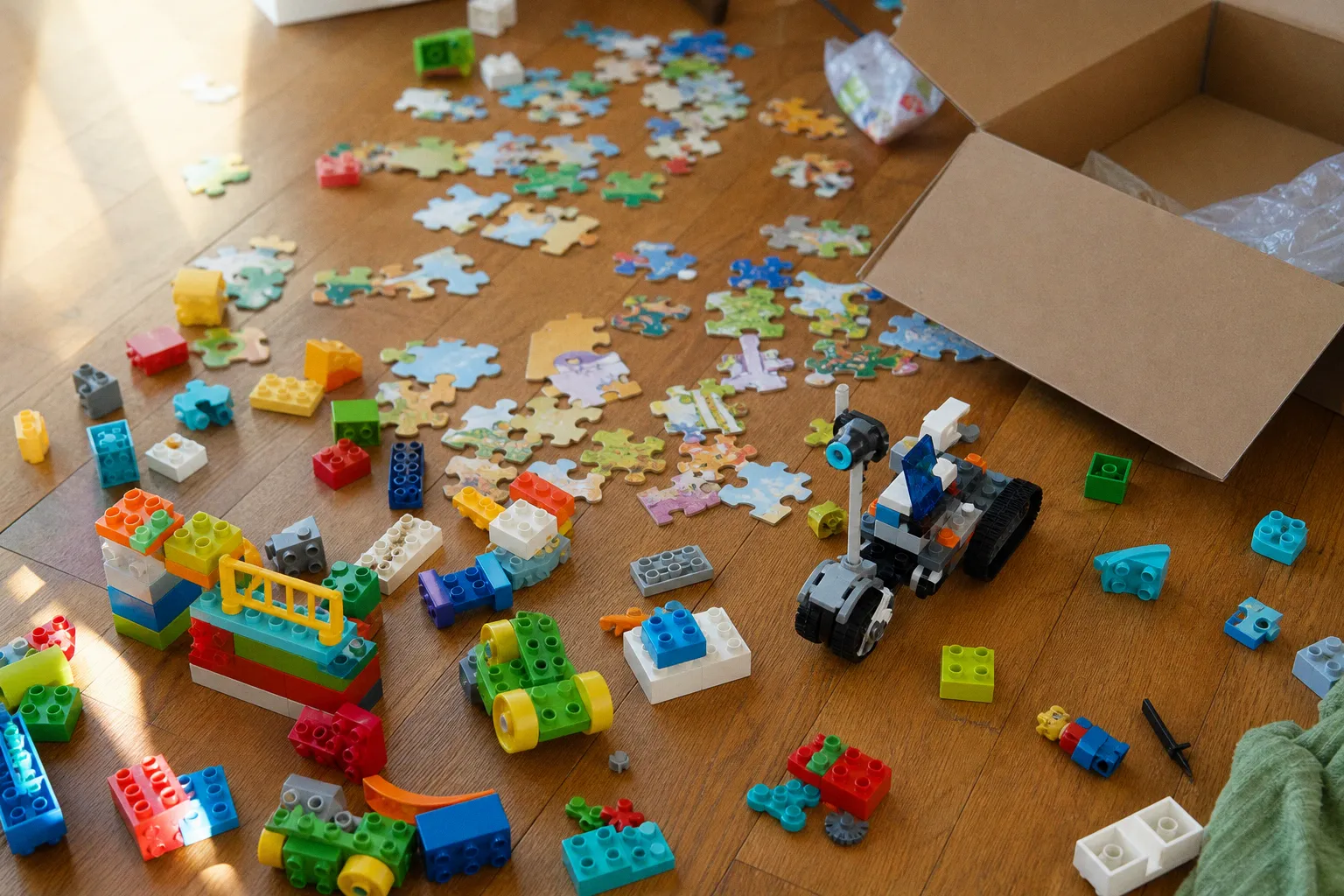
That distinction separates the major toy subscription models. Lovevery, Lalo, and KiwiCo Panda Crates send playthings to keep. Rental services such as Whirli offer access rather than ownership, with the obvious clutter advantage and a less obvious long-term-cost problem. Then there are lower-cost STEM monthly toy box options that trade polished wood and developmental sequencing for repeatable projects.
I look at these services through a household filter: how long does a child play independently, what survives being dropped or chewed, what becomes a choking hazard after one missing piece, and how much parent setup or cleanup arrives in the box with the toy.
A toy subscription is not automatically a toy rotation solution. If the toys stay in your house, the clutter still belongs to you.
The economics of ownership: Lovevery, Lalo, and KiwiCo models
The ownership model makes the most sense for parents who want fewer toys overall but are willing to pay more for each one. You receive a curated developmental set, keep it, and ideally reuse it for a younger sibling, pass it along, or resell it. “Ideally” matters here. A toy may be beautifully designed and still get ignored after six minutes.
Lovevery is the most established version of this model. Its Play Kits cover ages zero to 60 months and include six to 11 Montessori-style toys and activity materials. Baby kits cost $80 and arrive every two months; toddler kits cost $120 and arrive every three months. The shipping cadence is sensible: infant development moves quickly, but few families need a new basket of toys every four weeks.
Lalo’s Play Boxes cover zero to 24 months. Subscription boxes cost $80 and arrive every two months during the first year, then every three months in the second. Individual boxes cost more, ranging from $95 to $142.50. That pricing structure makes the subscription the rational route only if you are committed to the sequence. Buying one box à la carte can be useful if you want to fill a narrow gap—grasping, object permanence, early problem-solving—without signing up for the full first-two-years program.
KiwiCo Panda Crates serve ages zero to 36 months and offer more price flexibility:
| Service | Age range | Price per box | What arrives | Ownership model |
|---|---|---|---|---|
| Lovevery Play Kits | 0–60 months | $80 baby / $120 toddler | 6–11 developmental toys and activity materials | Keep everything |
| Lalo Play Boxes | 0–24 months | $80 subscription | Fixed milestone-oriented toy sets | Keep everything |
| KiwiCo Panda Crate Essentials | 0–36 months | $50 | 4–7 toys | Keep everything |
| KiwiCo Panda Crate Plus | 0–36 months | $80 | 5–9 toys | Keep everything |
| KiwiCo Panda Crate Deluxe | 0–36 months | $90 | 6–10 toys plus a book | Keep everything |
The headline price is not the whole calculation. A $120 toddler box every three months works out to roughly $40 per month, but it does not feel like $40 per month when the charge lands at once. A $50 KiwiCo box looks easier to absorb, but it may overlap with toys and board books already in your house. And the “we can use it for the next baby” argument only holds if you plan on another child with a similar enough age gap, have storage space, and do not lose half the parts in the meantime.
Durability is where ownership kits earn some of their premium. Well-made wooden objects, simple puzzles, nesting pieces, and basic fine motor tools can take years of rough handling. They are also easier to hand down than toys tied to a narrow novelty mechanic. But durable does not mean universally engaging. A toddler can reject a solid wood object permanence box just as firmly as a flashing plastic toy. The difference is that the wooden box will still be sitting there, looking expensive and mildly accusatory.
Predictability versus variety in developmental play kits
Parents tend to say they want surprises. What they usually mean is that they want a good selection without having to research it. They do not want a genuinely unpredictable box that duplicates three toys they already own or arrives at the wrong developmental moment.
Lovevery and Lalo have the advantage here. Their sets are fixed by age and developmental stage, so you can see the basic logic of what you are getting: early visual tracking, grasp development, bilateral coordination, cause and effect, early language, then more involved problem-solving. The toys are not random filler around a single good item. That is valuable for first-time parents especially, because it reduces the temptation to buy every “must-have” sensory toy after midnight scrolling.
KiwiCo Panda Crates take a different approach. They show examples of possible contents but do not guarantee that every subscriber receives the exact same toys. This is not necessarily a flaw. It gives the service some flexibility and may make boxes feel fresher. But it is a real trade-off for a family trying to build a deliberate toy shelf.
A predictable box works better if you are trying to avoid duplication. A variable box works better if you enjoy discovery and are not overly invested in receiving a specific item shown in a product photo.
Here is the practical way I would sort the decision:
1. Choose a fixed developmental sequence if you are building from almost nothing. Lovevery and Lalo are easier to slot into a sparse nursery or playroom because you can anticipate the categories of play arriving. That matters when you are trying not to own five versions of the same rattle.
2. Choose more variety if your child’s attention span is the bigger problem. A child who cycles through toys quickly may respond well to the changing mix in a Panda Crate. Just do not confuse “new” with “better.” A box can provide novelty without producing sustained independent play.
3. Do not pay for a premium kit to solve a rotation problem you refuse to manage. Even the best toy subscription becomes background clutter if every item stays visible all the time. Put out a limited set, store the rest, and rotate. This is not a glamorous strategy. It works anyway.
4. Watch the loose-part count. A toy with several removable pieces may support sequencing, matching, or fine motor work. It also creates a cleanup job and eventually a missing-piece issue. For babies and younger toddlers, every detachable item needs an age-appropriate size and direct supervision. “Educational” is not an exemption from choking-hazard reality.
The attention-span test is blunt but useful. In my house, I give a new toy a few short sessions over several days before calling it a keeper. For infants, that may mean repeated reaching and mouthing. For a toddler, I want to see them return to it without an adult restarting the activity. If the toy only works when a parent narrates every step, resets every piece, and performs the first round, it is not independent play. It is a parent-led activity in a nice box.
The toy that holds attention for ten quiet minutes on an ordinary Tuesday is worth more than the one that looks impressive in an unboxing video.
The rise and fall of rental services: access is not the same as savings
A toy rotation service is appealing because it addresses the least romantic part of children’s stuff: accumulation. Babies outgrow toys fast. Toddlers change interests with no warning. A rental model lets you send things back instead of finding a resale group, sanitizing every part, and hoping no one notices the crayon marks.
Whirli, for example, uses a token-based rental model starting at £9.99 per month. Families can keep toys for as long as they want, swap when ready, and purchase toys they decide to keep. The company says each toy is shared by an average of 10 to 15 families. That reuse model has a straightforward appeal: fewer underused toys being bought new, less storage pressure at home, and more access to larger or short-lived play items.
For a household with limited square footage, that can be genuinely useful. Large construction sets, ride-on toys, pretend-play kits, and phase-specific baby gear all have a predictable arc: intense interest, then sudden abandonment. Renting can be a cleaner match than ownership for those categories.
But educational toy rental is not always the bargain its marketing suggests. The monthly fee continues as long as you want access, and shipping or tier restrictions can change the math depending on the service and location. Keep a toy for long enough and you may spend more than buying a comparable item once. The cost advantage is strongest when you actively rotate, return toys promptly, and avoid treating the rental catalog as permanent storage.
There is also a market lesson here. Montessori-inspired subscription brands are not immune to operational reality. Monti Kids and Tiny Earth Toys have both shut down their subscription operations; Tiny Earth Toys closed in late 2023 and later partnered with PlanToys USA. That does not mean every toy rental service is unstable. It does mean parents should not build their entire play setup around the assumption that a niche subscription will always be there next year.
Rental is best used as one layer of a toy system, not the entire system. Keep a small core collection: open-ended blocks, basic books, a few reliable fine motor tools, and whatever comfort objects your child actually loves. Rent the bulky, highly specific, or rapidly outgrown items. That is where access beats ownership.
Budget STEM boxes: better for projects than permanent play shelves
Not every educational box needs to be a premium early-childhood toy kit. For school-age children, STEM subscriptions often offer a cleaner value proposition because the box is centered on an activity rather than a long-term toy collection.
Science4you starts at $19.99 per box, below KiwiCo’s stated starting price of $24 and CrunchLabs’ starting price of $24.95. At that level, parents should adjust expectations. You are paying for a guided experiment, materials, and a reason to sit down and make something—not necessarily for heirloom-grade components that will survive years of use.
That is fine. In fact, it is often better aligned with how older kids engage. A physics build, chemistry-style experiment, or engineering challenge can hold attention for an afternoon, reinforce sequencing and problem-solving, and then be done. Not every educational purchase needs to earn permanent shelf space.
The mess factor, however, changes sharply with STEM kits. A toddler toy box may leave you with a few blocks and a cloth book. A science kit can leave powder, tubing, paper scraps, paint, small fasteners, or a half-built device occupying the dining table for three days.
Before subscribing, be honest about which version of educational play your household can support:
- Low-supervision families should favor build kits with clear visual instructions, contained components, and a result the child can return to independently.
- Families with younger siblings need to treat small parts as a real separation issue, not an afterthought. A “for ages eight-plus” kit cannot be assembled on the floor while a toddler crawls through it.
- Children who dislike open-ended tasks may do better with a defined project and a visible finish line than with a broad craft box full of possibilities.
- Children who need repetition may get more developmental mileage from a few reusable tools than from a new experiment every month.
The best monthly toy box for an older child is not necessarily the most elaborate. It is the one that creates enough productive friction to be interesting without turning the parent into a lab technician.
Calculating the true cost: ownership, rotation, and the forgotten cleanup fee
The most useful comparison is not box price against box price. It is cost per meaningful use.
A premium owned kit can be a good deal if it produces repeated play across several months, works for more than one child, and replaces impulse purchases. A rental subscription can be a good deal if it prevents you from buying bulky toys with a short lifespan. A budget STEM box can be a good deal if it gets used fully rather than joining the pile of unopened “rainy day” activities.
What parents routinely undercount is the cleanup fee. Not a literal charge—the cost in time, attention, storage, and patience.
An owned toy creates four obligations:
- finding a place for it after the developmental window closes;
- keeping track of parts, manuals, and batteries if applicable;
- deciding whether to sell, donate, or pass it down;
- resisting the urge to keep it “just in case.”
A rental toy creates a different set:
- remembering return windows and swap logistics;
- keeping packaging or managing shipping materials;
- checking condition before sending it back;
- accepting that a favorite toy may eventually need to leave.
Neither system is automatically lower effort. The right one depends on what kind of household friction you dislike more: clutter or logistics.
For babies and young toddlers, I lean toward ownership when the kit is tightly matched to developmental milestones and built to last. Lovevery, Lalo, and the higher Panda Crate tiers are expensive, but they can reduce random buying when used intentionally. Lalo’s narrower 0-to-24-month range may work for families who want a structured first-two-years plan without committing through preschool. Lovevery’s coverage through 60 months makes more sense for parents who want a longer runway.
For families that already have plenty of toys, the better move may be no new ownership subscription at all. Use a rental service for large or novelty-heavy items, rotate what you own, and buy only the gaps you can name clearly. “We need something for bilateral coordination” is a reason. “The box looked cute online” is not.
The strict verdict: select an ownership-based toy subscription if you want developmental guidance, can commit to rotating toys at home, and have enough storage to keep the winners. Select a toy rotation service if space is your limiting factor and you will actively swap rather than let rental fees run indefinitely. Select a budget STEM box when the child is old enough to follow a project and you want engagement more than a permanent toy collection.
Parental supervision remains the final filter. If a box requires constant setup, close monitoring around small parts, and a full cleanup operation every time, it is not buying you time. It is assigning you another task.
FAQ
Should I choose an ownership-based subscription or a rental service?
Are toy subscriptions actually cheaper than buying toys individually?
Why do some toy subscription companies go out of business?
How can I tell if a toy subscription is worth the money?
Do I need to worry about small parts in subscription boxes?
 Kids & Education BoxesMatch Children's Book Clubs to Your Kid's Reading Level
 Kids & Education BoxesKids subscription box guide: what to buy and what to skip
 Kids & Education BoxesToy subscription box verdict: what to buy and key caveats
 Beauty & Fashion BoxesCompare Clean Beauty Boxes Under $40 for Sensitive Skin