Global snack boxes compared on variety, cost, and taste
It is explained by box size, country focus, shipping, customs, and how much of the monthly price is spent on the experience rather than edible volume.
There is no clean, verifiable MSRP calculation across these services. Many items are regional retail products, limited editions, or single-serving imports with no consistent U.S. shelf price. So the useful comparison is not a claimed “retail value.” It is delivered cost, snack count, country coverage, and the chance that filler items consume the budget.
For a low-cost entry point, SnackCrate Mini starts at $9.99 for five to six snacks. For a Japan-focused box, TokyoTreat and Sakuraco start at $32.50 on annual plans, before shipping. Bokksu starts at $39.99 per month, then adds shipping and, for U.S. customers, a customs duty. Universal Yums is the cleanest price structure for U.S. buyers: $19 to $41 per box with free domestic shipping.
The market is growing. Global snack box subscriptions were valued at $8.6 billion in 2025 and are projected to reach $21.4 billion by 2034. That does not make every box good value. It means more companies will sell convenience, scarcity, and country-themed packaging at a premium.
The headline price is not the cost. The delivered cost is the cost.
The market grew because snacks are easier to ship than meals
Meal kits have cold-chain problems, spoilage risk, and a narrow delivery window. Snack boxes do not. A box of cookies, candies, chips, tea, and shelf-stable drinks can travel across borders without insulated packaging or a delivery appointment. This makes the category operationally simple compared with meal delivery.
It also makes the marketing simple. A monthly country reveal gives a subscription service a repeatable story. The customer gets a destination. The company gets a rotating theme. The actual product economics can remain opaque.
The core formats now fall into three groups:
- Single-country boxes: Usually Japan-focused. These sell depth, cultural context, and products tied to one market.
- Rotating-country boxes: One country or region per month. The subscription is structured around surprise and comparison.
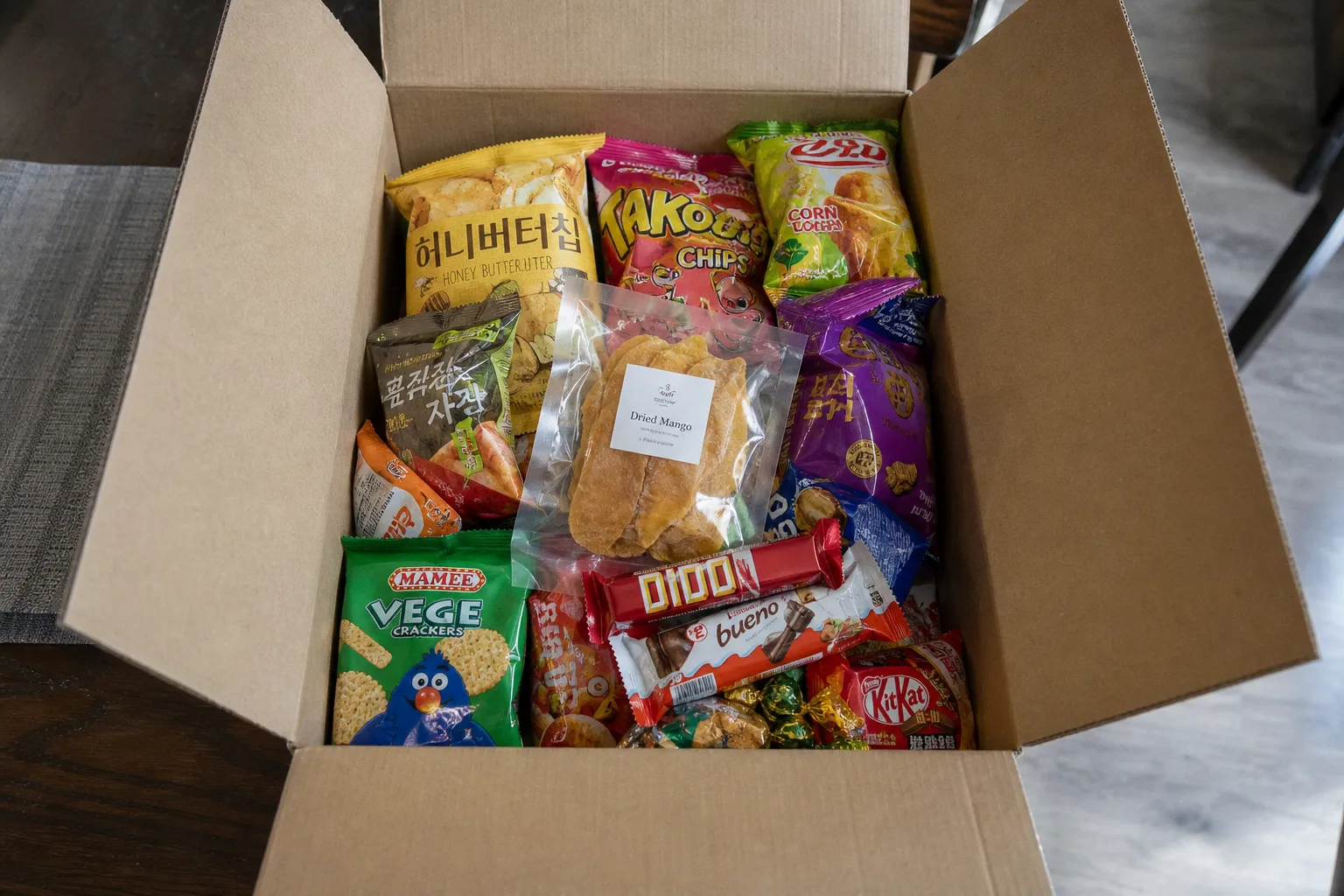
- Multi-country assortments: Several countries in one carton. This increases variety but weakens the sense of a coherent regional food experience.
The distinction matters because “global” does not always mean broad coverage. A TokyoTreat box may contain more Japanese novelty products than a rotating international box contains snacks from any single country. A MunchPak can offer more geographic spread in one delivery, but the assortment may not tell a connected story.
Taste is not a valid winner-takes-all metric. Someone who wants shrimp chips, yuzu candy, and sweet corn puffed snacks is not buying the same product as someone who wants familiar cookies with foreign packaging. The measurable part is how much choice and volume each service provides for the monthly charge.
Japanese specialists: Bokksu, Sakuraco, and TokyoTreat sell different versions of Japan
Japan is the most crowded premium lane in the international snack box comparison market. The products are exportable, packaging is strong, and seasonal flavor releases create a steady supply of limited-run items. But these three services are not interchangeable.
TokyoTreat leans toward modern convenience-store snacks, candy, and a drink. Sakuraco positions itself closer to traditional snacks, tea, and homeware. Bokksu operates in the higher-cost segment, with a stronger premium-gift framing and a starting subscription price of $39.99 per month.
TokyoTreat: novelty snacks, but shipping changes the math
TokyoTreat lists plans from $32.50 per month on a 12-month commitment to $37.50 for a one-month plan. Shipping is extra. Depending on destination, that charge ranges from $10.50 to $14.99.
That produces a basic problem for the casual buyer. The low advertised monthly rate requires an annual commitment. The flexible one-month plan can land near or above $48 before any local tax effects, depending on destination. This is not a minor surcharge. Shipping can add roughly one-third of the product price.
TokyoTreat makes sense for a buyer who specifically wants current Japanese candy, instant noodles, chips, and a drink included in the assortment. It is not the cost-efficient choice for someone who only wants Japanese snacks in general. Specialty grocers and Asian markets often reduce the per-item cost, although they cannot replicate the monthly curation or limited-edition selection.
Sakuraco: more traditional positioning, less raw snack volume
Sakuraco uses a similar pricing structure: $32.50 per month on a 12-month plan and $37.50 for a single month. Shipping runs from $10.50 to $12.50 per box.
The box is built around traditional Japanese snacks and tea, with authentic homeware included as part of the concept. That homeware is not automatically a value add. If the item is a plate, cup, or small dish you will use, it has utility. If it goes into a cabinet, it is a non-food filler item with a high shipping footprint.
Sakuraco’s price is easier to defend when the subscriber wants tea and Japanese tableware alongside the snacks. If the goal is purely edible volume, those inserts dilute the food budget.
Bokksu: premium price, premium freight exposure
Bokksu starts at $39.99 per month. Its U.S. shipping changed effective May 1, 2026, to $13.99 per box plus a $3 customs duty. That produces a minimum delivered monthly cost of $56.98 before applicable taxes.
For subscribers in the UK, EU, Canada, and Australia, shipping is listed at $15.99. Other international rates vary from $9.99 to $29.99. The shipping line is not incidental. It determines whether Bokksu is a specialty purchase or a recurring expense that has outgrown the product category.
At nearly $57 delivered in the U.S., Bokksu needs to be judged against premium imported snack shopping, not against a $20 surprise box. Its useful audience is narrow: buyers who value curated Japanese regional products and accept the logistics surcharge. Anyone treating it as a monthly snack bargain should skip it.
| Service | Advertised starting price | Shipping structure | What the box is actually selling |
|---|---|---|---|
| TokyoTreat | $32.50/month on 12-month plan | $10.50–$14.99 extra | Modern Japanese snacks, candy, drink |
| Sakuraco | $32.50/month on 12-month plan | $10.50–$12.50 extra | Traditional snacks, tea, homeware |
| Bokksu | $39.99/month | U.S.: $13.99 + $3 duty; other markets vary | Premium Japanese curation |
| Universal Yums | $19/box | Free shipping in the U.S. | One-country monthly theme |
| SnackCrate | $9.99/month | Varies by order and destination | Low-cost rotating-country surprise |
| MunchPak | $17.95/month | Depends on delivery location | Multi-country assortment |
Japan-focused boxes are not expensive because the snacks are magical. They are expensive because cross-border shipping is built into the business model.
Universal Yums, SnackCrate, and MunchPak: three different definitions of “world”
The lower and middle tiers are where buyers can get distracted by snack counts. A listed count is useful, but it is not a weight measurement. A box with 12 full-size chips, cookies, and candy bars is not equivalent to a box with 12 small chews, lollipops, and wafer packets.
Still, the published tier structure gives a reasonable first filter.
Universal Yums: the strongest domestic shipping proposition
Universal Yums has three box sizes:
1. Yum Box: Five to seven snacks, starting at $19 per box.
2. Yum Yum Box: Ten to 12 snacks, starting at $27 per box.
3. Super Yum Box: Fifteen to 18 snacks plus a drink, starting at $41 per box.
U.S. shipping is free. That matters more than it sounds. The $19 starting price remains $19 before tax. There is no surprise freight calculation at checkout that changes the comparison.
The Yum Yum Box is the practical middle tier. At a starting price of $27 for 10 to 12 snacks, the simple cost per stated item falls roughly between $2.25 and $2.70. That is not a claim about per-ounce value. It is a count-based reference point. The actual cost per ounce may be worse if the box relies heavily on small candy, but the tier is less exposed to the single-item pricing distortion of the smallest box.
Universal Yums is best for buyers who want one country explored at a time without paying Japan-specialist shipping. The limitation is obvious: the service’s country rotation means no control over the monthly destination. If you are trying to buy snacks from a specific country, a subscription is a poor procurement tool.
SnackCrate: low entry price, less room for meaningful curation
SnackCrate offers:
- Mini: Five to six snacks for $9.99 per month.
- Original: Ten to 12 snacks for $21.99 per month.
- Family Size: Eighteen to 20 or more snacks for $44.99 per month.
The Mini tier is cheap enough to function as a sample, not a substantial food box. Five to six snacks at $9.99 works only if expectations are controlled. The buyer is paying for international variety and surprise, not pantry replenishment.
The Original tier is the more rational comparison. At $21.99 for 10 to 12 snacks, it competes directly with Universal Yums’ $27 Yum Yum Box. SnackCrate has the lower sticker price. Universal Yums has free U.S. shipping stated upfront and a more explicit country-theme structure. The better choice depends on the final checkout total and whether you want a monthly country narrative or merely a rotating international assortment.
The Family Size tier has the weakest automatic value case. Forty-four dollars is enough money to buy targeted imported snacks from a local specialty store or online retailer. It only works if the box serves multiple people and the group actually consumes the full category mix. Otherwise, duplication and unwanted flavors become depreciation: paid product that loses value the moment it sits untouched in a pantry.
MunchPak: broad geography, weaker regional depth
MunchPak has three core tiers:
- MunchPak Mini: Five to six snacks starting at $17.95 per month.
- Original MunchPak: Ten or more snacks starting at $28.95 per month.
- FamilyPak: Twenty or more snacks starting at $42.95 per month.
Unlike country-specific boxes, MunchPak can include products from multiple countries in one shipment. That is its point. It is not a single-country deep dive.
The Mini tier is difficult to justify beside SnackCrate Mini. At $17.95 for five to six snacks, it costs substantially more than SnackCrate’s $9.99 entry tier before shipping differences are known. MunchPak needs its broader assortment quality to carry that premium. There is no guaranteed way to verify that before subscribing.
Its distinguishing feature is customization. Subscribers can request preferences, such as no spicy products or gummies only, for an extra $1 per preference. This is a small fee, but it has a larger implication: the subscription knows surprise creates waste. A dollar to remove an entire category can be rational if it prevents multiple unwanted items.
Shipping, duties, and commitment terms are where the price breaks
The central financial mistake in a world snack subscription review is comparing monthly product prices while ignoring delivery charges and plan length.
A $32.50 Japanese box with $12 shipping is a $44.50 box. A $39.99 box with $16.99 in U.S. shipping and duty is a $56.98 box. The difference between those totals is enough to fund a separate grocery purchase.
There are four cost layers to separate before signing up:
- Subscription rate: The advertised monthly price. This may require a three-, six-, or 12-month prepayment.
- Shipping: Often free for domestic services, often material for imported Japanese boxes.
- Customs and duty: Bokksu explicitly adds a $3 customs duty for U.S. subscribers under its current rate structure.
- Unused product: The hidden cost. A $3 snack you do not eat has no practical value, regardless of its supposed retail price.
Annual plans lower the stated monthly rate. They also transfer risk to the buyer. You are prepaying for future selections, future shipping conditions, and your own future interest in the category. That is not always bad. It is simply not the same transaction as a month-to-month subscription.
TokyoTreat and Sakuraco show the trade-off clearly. The $32.50 rate is tied to a 12-month plan, while the one-month rate is $37.50. A buyer who wants to test one box should calculate from the flexible rate, not the annual-plan figure. Using the cheapest possible rate in a comparison is a marketing convention, not a consumer-cost calculation.
Customization reduces waste. It also reduces the point of some boxes.
Snack subscriptions sell selection on the company’s terms. That is curation. If the service chooses well, the lack of control feels like discovery. If it chooses poorly, the customer has paid a markup for a random inventory mix.
MunchPak is the clearest example of the compromise. Its $1-per-preference option can exclude spicy snacks or skew the box toward gummies. This has direct utility for households with limited tolerance for heat, dietary restrictions, or children who will not eat certain categories. But every added preference shifts the box away from a true global tasting experience.
The same logic applies to Japanese specialists. TokyoTreat’s modern snack focus may include products that appeal to buyers seeking novelty but not to buyers looking for traditional Japanese confectionery. Sakuraco may be a better fit for tea and wagashi-style preferences, but the homeware inclusion is only useful if it has a job after the snacks are gone.
Use the box type to match the actual objective:
1. Choose Universal Yums if you want a country-by-country format, a transparent U.S. delivered price, and a middle-tier box that does not rely on international freight math.
2. Choose SnackCrate Mini or Original if the priority is a low entry cost and you accept that the surprise-country format may include small items or categories you would not buy yourself.
3. Choose MunchPak if breadth matters more than cultural depth and you are willing to pay extra to filter out obvious waste.
4. Choose TokyoTreat if current Japanese convenience snacks and a drink are the product you want, not merely “Japanese snacks.”
5. Choose Sakuraco if tea, traditional snacks, and occasional homeware have real use in your household.
6. Choose Bokksu only after accepting the delivered cost. It is a premium import subscription, not a budget snack crate.
The verdict: buy the format, not the marketing language
For U.S. buyers, Universal Yums has the most defensible pricing structure. Its $19, $27, and $41 tiers include domestic shipping, which removes the largest source of checkout distortion. The $27 Yum Yum Box is the sensible starting point for a snack subscription box around the world: enough stated items to assess the format, without moving into the $40-plus range where targeted imported shopping starts to make more financial sense.
SnackCrate is the budget test. The $9.99 Mini tier is a low-risk way to see whether monthly international snack discovery has any utility for you. Do not confuse low entry price with strong value. Small snack counts leave little room for a meaningful country experience.
TokyoTreat and Sakuraco are niche purchases with predictable shipping drag. They are worth considering only when the Japan-specific format is the goal. Bokksu is the clearest wait for a promo code case. A $39.99 starting price becomes at least $56.98 delivered in the U.S. under its current shipping and duty structure. That is too much for an open-ended monthly food subscription unless its curation matches your preferences with unusual precision.
The blunt version: buy Universal Yums for structured global variety, buy SnackCrate to test the category cheaply, and skip premium Japanese boxes unless you would willingly spend $45 to $57 on imported snacks every month. The snacks may be interesting. The freight bill is not.