Monthly toy subscription box services tested for durability
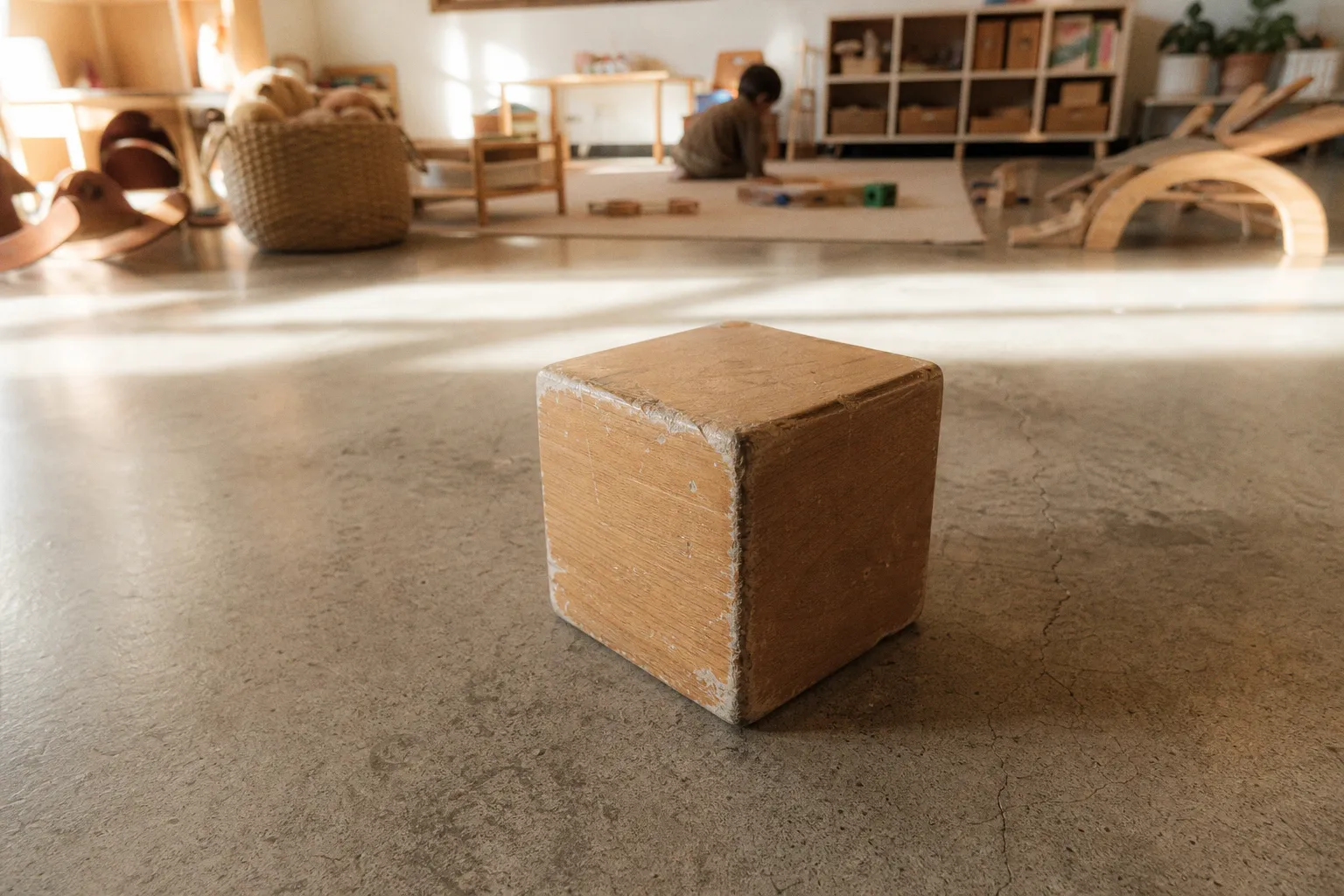
It does not tell you whether the contents will survive a second child, a second afternoon, or a single drop from a dining chair.
The raw math is uneven. Entry-level KiwiCo project crates typically run about $20 to $30 per month. Lovevery Play Kits and Panda Crates land around $80 per shipment, usually delivered every two or three months. Circular rental services such as Tiny Earth Toys and Green Piñata generally cost $35 to $65 per month for five to 10 toys per rotation. Those prices are not interchangeable. Neither is the product.
A cardboard rocket, a wooden object-permanence box, and a rented HABA push toy may all be sold as "developmental play." Their depreciation schedules are radically different.
The useful question is not whether a toy box is educational. It is how much usable play survives after the first project, the first spill, and the first child outgrows it.
The safety baseline: ASTM F963-23 is not a durability guarantee
Every commercial toy intended for children 12 and under and sold in the United States must comply with federal toy safety requirements. Since April 20, 2024, the mandatory standard is ASTM F963-23, incorporated through 16 CFR Part 1250. This sits alongside CPSIA requirements for chemical limits, including a 90 ppm cap on lead in accessible substrates and a 0.1% limit on regulated phthalates in applicable components.
That is the floor. It is not a quality score.
ASTM testing addresses hazards that become dangerous when a toy fails: detached small parts, sharp edges, accessible hazardous materials, weak seams, and structural breakage. A small-parts cylinder measuring 31.7 mm, or 1.25 inches, is used in testing products intended for children under three. If a detached component fits inside it, that component creates a choking-risk problem.
Mechanical evaluations can include:
- Drop and impact testing, which checks whether a toy fractures or releases hazardous components after expected impacts.
- Torque and tension testing, which pulls and twists components such as knobs, eyes, wheels, and fasteners.
- Small-parts testing, which evaluates whether pieces can detach and create a choking hazard.
- Sharp-edge and structural assessments, which look for breakage that turns a safe toy into a cut hazard.
None of this means every item will look good after two years. It means the product must not create specified hazards under the applicable test conditions. A safe cardboard craft can still be landfill material by Sunday. A compliant plastic gadget can still have a weak hinge. A solid-wood toy can still chip, split, or swell if it is soaked, thrown onto concrete, or left outdoors.
That distinction gets lost in subscription marketing because "tested" sounds like "built for life." It is not the same claim.
Lovevery, KiwiCo, and rental rotations are selling different useful lives
A monthly toy box comparison fails when it treats all boxes as if they contain the same category of product. They do not.
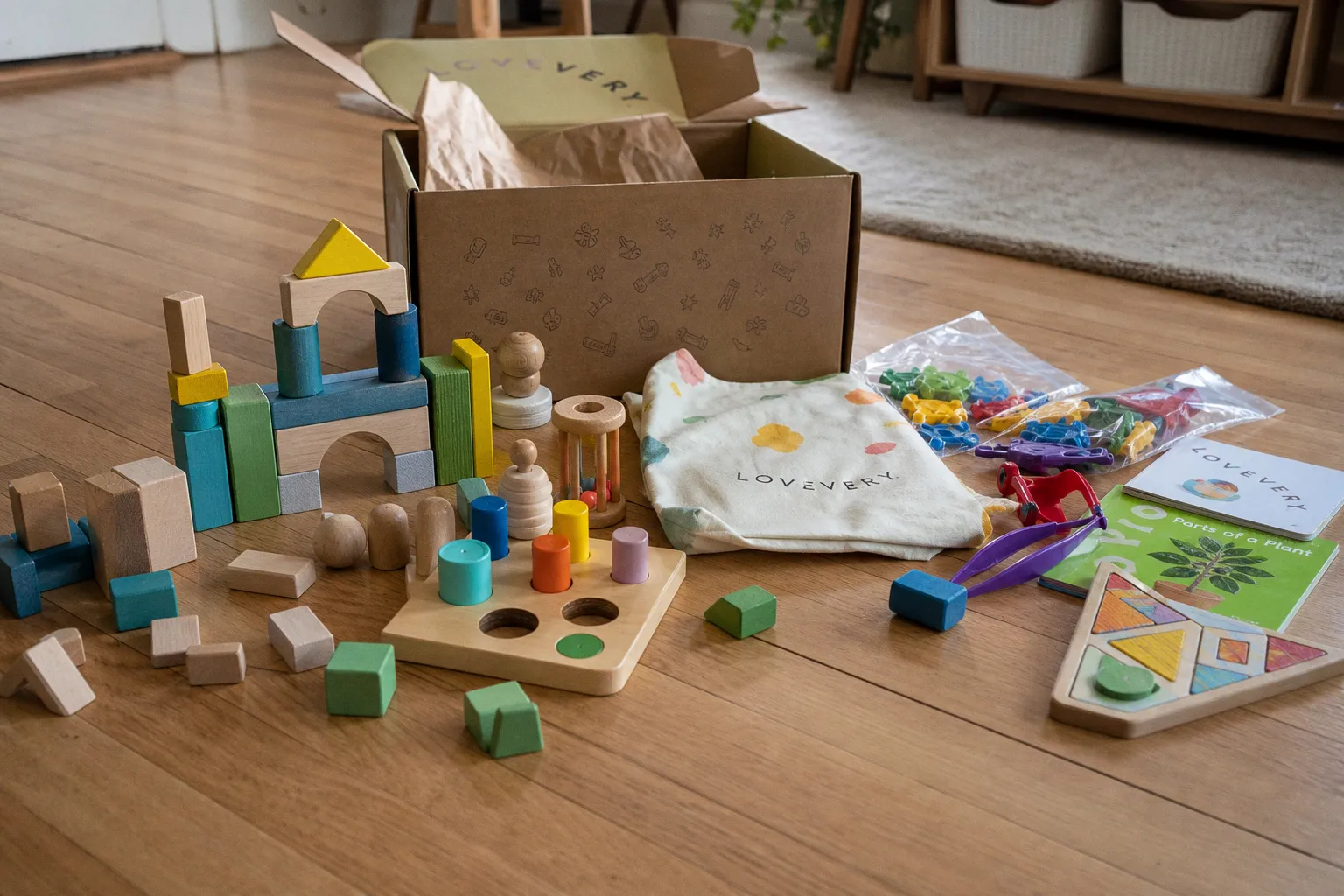
Lovevery's model is closer to a purchase-based developmental equipment program. Its kits use materials such as solid wood, FSC-certified Baltic birch plywood, food-grade silicone, and water-based finishes. The stated design premise is multi-child use. That does not make every component permanent, but it changes the cost calculation. A wooden puzzle, posting box, or silicone teether can retain utility long after the original age guide has passed.
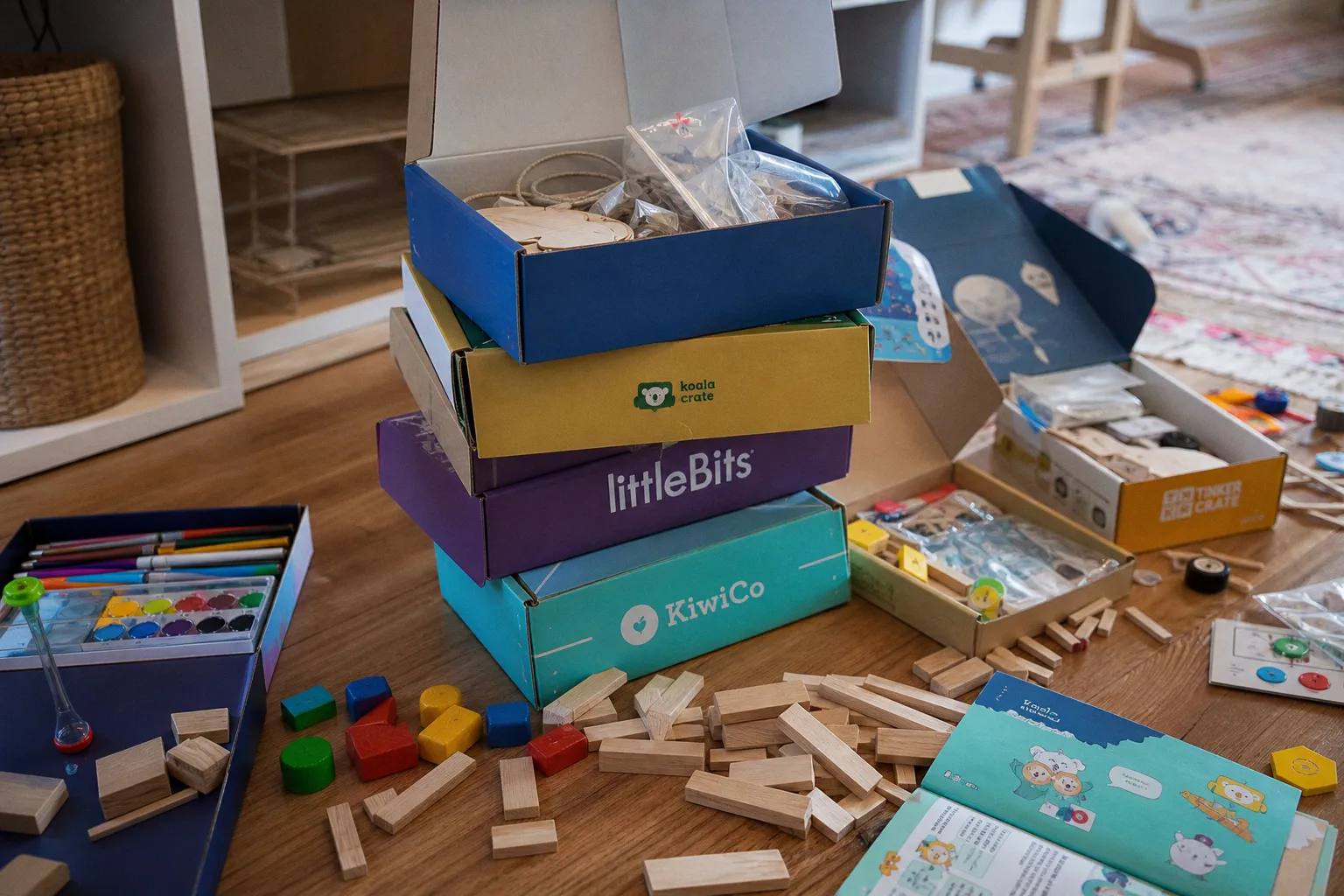
KiwiCo operates differently. Its crate lines are project-driven. The company reports independent third-party laboratory testing for structural integrity and durability, plus more than 1,000 hours of design and kid-testing work per crate line. That is meaningful process information. But the output remains mixed by design: some components are reusable tools or toys, while others are paper engineering, cardboard structures, adhesive assemblies, paintable parts, and consumables.
A rental subscription is a third category. Tiny Earth Toys and Green Piñata circulate toys across households after inspection and sanitization. Their economics depend on products that can tolerate repeated handling, cleaning, packing, shipping, and reissue. That pushes these services toward established durable-toy brands, including wooden products from Hape, PlanToys, and HABA.
| Durability factor | Lovevery-style purchase kits | KiwiCo project crates | Circular toy rental boxes |
|---|---|---|---|
| Primary value proposition | Long-term developmental tools | Guided making and STEAM activities | Access to a changing toy library |
| Typical material profile | Wood, plywood, silicone, fabric, selected plastic | Mixed: cardboard, paper, plastic, wood, consumables | Durable wood and commercial-grade plastic toys |
| Expected useful life | Often multi-stage or multi-child | Varies by project; many builds are short-cycle | Designed for multiple households and rotations |
| Depreciation pattern | Slower if pieces remain complete | Fast for consumable or display-only projects | The subscriber does not carry resale risk |
| Replacement risk | Subscriber owns missing or damaged pieces | Usually limited to a project's immediate use | Damage policies matter more than resale value |
| Best fit | Families building a long-term toy base | Families buying structured activities | Families avoiding toy accumulation |
The $80 Lovevery figure looks high until the delivery interval is factored in. At every two to three months, the effective monthly outlay is roughly comparable to or moderately above a rental program, depending on the plan. But the ownership model differs. With Lovevery, the household keeps the asset. With a rental box, the household is paying for access, curation, cleaning, and storage relief. With KiwiCo, the household is often paying for the activity itself, not an object with meaningful resale value.
That is not a criticism. It is an accounting correction.
A single-use engineering build is not "poor quality" because it expires. It is poor value only when sold as a lasting toy.
Material tells the truth before the product page does
Parents looking for durable toy subscriptions should read the materials list before reading the developmental claims. Material composition predicts wear more accurately than most marketing language.
Solid wood and plywood: high utility, not invincibility
Solid wood is the strongest material category in this comparison when the toy is well designed. It handles repeated gripping, stacking, pushing, sorting, and dropping better than thin molded plastic or paperboard. It also tends to age visibly rather than catastrophically: finish wear, dents, and small scuffs are common; total failure is less common.
Plywood deserves a separate note. Baltic birch plywood can be stable and durable in layered construction, but the edges and finish matter. Repeated moisture exposure can damage layers. A toy left in a damp garage or soaked in a sink does not become "heirloom" because the product page said FSC-certified.
Wood also has a practical advantage for subscription resale and hand-me-down value. A complete wooden sorting toy with minor cosmetic wear can remain useful. A cardboard activity board with peeled graphics cannot.
Silicone and fabric: durable within a narrow job description
Food-grade silicone works well for teethers, bath-safe components, and flexible sensory items. It is washable and does not splinter. Its failure mode is usually surface damage, tearing, or deformation after misuse, not a sudden break.
Fabric accessories can last, but only if the seams, closures, and internal fill are designed for the age group. Plush and cloth books accumulate laundering damage, stains, and lost shape. They also have almost no resale value unless they remain unusually clean and complete.
Cardboard, paper, and foam: consumables with an educational label
Cardboard is not fraudulent. It is simply short-lived. For many STEM activities, that is entirely rational. Children need to test bridges, launch paper flyers, build mechanisms, paint models, and make mistakes. These are not defects in the format. They are the format.
The problem begins when a service prices a crate as though every included item is a permanent toy. A cardboard machine can teach a real principle. It can also have a cost-per-use of $25 after one afternoon. Both statements can be true.
For KiwiCo-style kits, assess the crate in two buckets:
1. Reusable components: tools, durable hardware, plastic mechanisms, quality wooden pieces, books, storage pieces, and components that support repeat experiments.
2. Consumed components: pre-cut cardboard, stickers, paint, glue, paper worksheets, foam shapes, and project-specific packaging.
If most of the shipment sits in bucket two, calculate the price as a structured class or activity kit. Do not compare it to an $80 wooden play kit that may stay in the home for years.
Rental toy subscriptions shift the durability burden, not the physics
Monthly toy rotation boxes make a clean promise: fewer toys in the house, more novelty, less money locked into items a child stops using after six weeks. The model can work. It also requires closer reading than an ownership subscription.
A rental provider cannot economically circulate fragile, low-grade items. Each damaged toy creates labor costs: inspection, cleaning, replacement, inventory loss, packing time, and customer-service friction. That is why circular services tend to select products already built for repeat handling.
Still, "professionally sanitized" does not answer every durability question. The operational chain is longer:
- A toy is returned.
- It is inspected for damage, missing parts, and unsafe wear.
- It is cleaned and sanitized under the service's process.
- It is repacked.
- It enters another household with another child and another pattern of use.
This model has an advantage over purchase boxes for families with limited storage or children who lose interest quickly. There is no pretense that every toy must earn permanent shelf space. But subscribers should inspect the service's damage policy before joining. A rental plan can become expensive if normal child use is classified as damage or if small replacement parts trigger full-item charges.
There is also a hygiene distinction worth keeping clear. Durability and sanitization are separate operational claims. A toy may be clean and still have loose hardware. It may be structurally sound and still be difficult to sanitize because of complex fabric, crevices, or water-trapping design. Good rental services need both controls.
The same basic discipline applies across consumer categories with safety or credential claims: the credentials and process descriptions are not a substitute for examining the actual service model. A sanitization protocol or a quality certification does not replace looking at how the operation actually runs.
What testing can reveal — and what brands do not publish
The kids toy subscription test parents want is straightforward: drop every item repeatedly, pull every joint, soak the washable pieces, and track failure rates over two years. That data is generally not public.
Brands do not typically disclose proprietary drop-test heights, stress-test thresholds, failure rates, or return data by product. As a result, any reviewer claiming to rank every subscription by exact lifetime is usually filling gaps with confidence.
What can be assessed without inventing numbers is the product architecture.
A toy with a single molded body, recessed fasteners, thick walls, and no decorative glued-on parts has fewer failure points than a toy assembled from thin tabs, adhesive dots, and exposed paper hinges. A wooden pull toy with fixed axles and large wheels has a different risk profile from a build-it-yourself vehicle that uses cardboard slots. A sensory bin with replaceable filler material is not intended to remain intact in the same way as a stacking set.
KiwiCo's reported third-party testing and extensive kid-testing are useful signals that design work exists upstream. But they do not change the expected life of consumable materials. A well-tested cardboard project remains a cardboard project.
Lovevery's material choices support slower wear, particularly in toddler products exposed to constant handling. But a strong material does not protect against missing pieces. In a multi-part kit, completeness is part of durability. A sorter without shapes, a puzzle without pieces, or a play set without its key accessory has suffered functional depreciation even if the main structure looks perfect.
Rental services face the opposite problem. Their toys may be physically durable, but the subscriber never captures residual value. That can still be the better transaction. If a family rotates through 10 toys monthly and avoids buying $300 worth of short-term-interest items, the access fee can be rational. If the child repeatedly requests the same item and the rental service cycles it away, ownership may be cheaper.
Real-world wear: match the box to how your child actually uses toys
The right monthly toy subscription box depends less on a child's stated age than on the household's wear pattern.
For children under three, the relevant question is not whether an item is "Montessori-inspired." It is whether it has large, secure components; a finish that tolerates wiping; and construction that does not create detachable parts after repeated mouthing, pulling, and dropping. ASTM F963-23 compliance is mandatory. The useful differentiator is how much use the toy can absorb after it clears that minimum.
For preschoolers, project subscriptions become more viable because the finished object may be secondary to the activity. A $25 crate that delivers 90 minutes of focused construction, a clear scientific concept, and a small reusable tool may be fair value. A $25 crate that contains an assembly activity lasting 20 minutes and no durable components is expensive entertainment.
For school-age children, the calculation shifts again. STEM kits can have a high utility-to-material ratio when they introduce real iteration: redesigning a mechanism, testing variables, using tools across projects, or extending an experiment. They have poor value when the child follows numbered steps once and the result cannot be used, modified, or displayed without breaking.
Use this practical filter before committing to recurring billing:
1. Separate permanent pieces from project waste. Count the components likely to remain functional after the activity. This is the denominator for any honest value calculation.
2. Check whether the age range matches the failure mode. A toddler's damage is impact and mouthing. A seven-year-old's damage may be overloading a mechanism or dismantling it to rebuild.
3. Price ownership and access differently. A purchase kit may cost more upfront but retain hand-me-down or resale value. A rental plan costs less in clutter but produces no asset.
4. Look for part management, not just material quality. A durable system with 18 loose pieces can become unusable faster than a less expensive one-piece toy.
5. Treat "eco-friendly" as a material claim, not a longevity claim. FSC wood, recycled packaging, and reusable shipping boxes are separate from how long the toy remains useful.
6. Measure cost per meaningful use. This is more honest than MSRP. A $30 activity used once costs $30 per use. An $80 kit used weekly for a year can be cheap even before any hand-me-down value is counted.
The verdict: buy the model, not the promise
For households building a stable toy collection, Lovevery-style kits have the clearest durability case. The materials, the multi-child design intent, and the slower depreciation pattern align with families who want to keep and reuse. Yes, the sticker price is the highest per shipment. The unit economics improve sharply when the same wooden posting toy moves from an 18-month-old to a 2-year-old to a hand-me-down cousin.
For households who want structured learning experiences and accept that much of each crate is intentionally disposable, KiwiCo's project model is rational. Judge it on the activity quality, the reusable tools, and the educational return — not on whether the cardboard contraption is still standing on Wednesday. Expect to spend a meaningful share of each shipment on materials that exist for one project.
For households short on storage, dealing with rapidly shifting interests, or trying to avoid the accumulation tax of childhood, a rental rotation makes operational sense. The subscription absorbs the depreciation that would otherwise sit in a closet. Read the damage policy line by line, because the durability question becomes a contractual one rather than a materials one.
A toy box is not durable because it is "tested," "eco-friendly," or "Montessori-aligned." It is durable when its materials, construction, and intended use match the way a child actually plays.
The smartest subscription is the one whose economic model matches the household's real wear pattern. A wood-and-silicone kit sold to a family that treats every shipment as one-afternoon entertainment will feel overpriced. A rental rotation sold to a family that wants long-term hand-me-downs will feel like a wasted middleman. Match the model to the mess, the storage, and the schedule — and the durability question answers itself.
FAQ
Does a toy being 'tested' mean it will last for years?
How should I evaluate the value of a project-based crate?
Are rental toy services more durable than buying kits?
Why is solid wood considered more durable than other materials?
What is the main risk of multi-part toy sets?
 Kids & Education BoxesMatch Children's Book Clubs to Your Kid's Reading Level
 Kids & Education BoxesKids subscription box guide: what to buy and what to skip
 Kids & Education BoxesToy subscription box verdict: what to buy and key caveats
 Kids & Education BoxesToy subscription comparison: what to select and the trade-offs